Facilities
 Tickets and guided tours
Tickets can be purchased at the ticket office on site or online at bilety.zamekczocha.com. Daytime tours are guided; the castle also organises night-time tours (booking required).
 Parking
There is a car park for visitors next to the castle.

 Restaurant
The castle is home to the „Uczta” Restaurant and the Myśliwska Café; a bonfire area has been set up by the castle moat.

 Hotel
The castle runs a hotel with rooms, including themed rooms, and a spa area. It is operated by AMW Rewita.

 Souvenirs
There is a gift shop for visitors in the castle grounds next to the entrance.
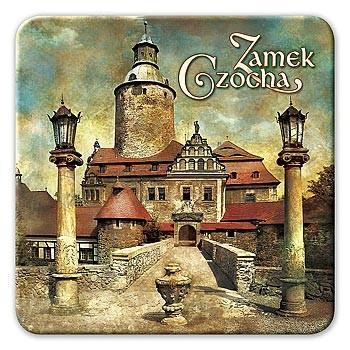


Czocha Castle stands on a rocky hill above the Leśniański Reservoir on the River Kwis, in the village of Sucha in the municipality of Leśna. It is one of Lower Silesia’s most famous strongholds: a medieval border watchtower, the seat of the von Nostitz family for over two and a half centuries, a collector’s residence romantically rebuilt in the early 20th century, and, after the war, a secret military base. Today it operates as a hotel, and the castle can be visited on a guided tour.
Genesis
The stronghold was built between 1241 and 1247 as a border fortress on the Silesian–Lusatian frontier. Sources disagree as to who founded it: its construction is attributed either to the Czech King Wenceslaus I or to the Silesian Piasts. Its location on a rock overlooking the Kwisa valley provided the stronghold with natural protection and control over the surrounding area.
The changing fortunes of the borderlands
As early as 1253, the castle was taken over by Brandenburg, which granted it as a fief to the Bishop of Meissen, its first known owner. In 1319, Czocha became part of the dowry of the Duchy of Javor, and in 1346 it was inherited by Duke Bolko II the Short. Following the death of his wife, Agnes of Habsburg, the castle passed into the hands of the Bohemian Crown under an agreement with Emperor Charles IV. Between 1389 and 1453, it belonged to the noble families of von Dohn and von Klüks.

The von Nostitz family
In 1451, the castle passed into the hands of the Lusatian von Nostitz family, who ruled it until 1700. This was the longest period of rule by a single family in the history of Czocha. Traces of this era have survived in the heraldry: stone cartouches and coats of arms of the Nostitz family, as well as those of other owners, can be seen today above the doorways and on the keystones.
Gütschow and Bodo Ebhardt’s redevelopment
In 1909, the castle was purchased for 1.5 million marks by Ernst Gütschow, a cigar manufacturer from Dresden. The new owner maintained good relations with the Tsar’s court, and after the revolution he bought items of high artistic value from Russian émigrés, which were then displayed within the castle’s interiors. Between 1912 and 1920, the Berlin architect Bodo Ebhardt rebuilt Czocha, modelling it on an engraving from 1703. The work gave the castle its current picturesque silhouette, but at the expense of many of its oldest parts, which were destroyed at the time.

The Second World War and the period after 1945
Gütschow lived in the castle until March 1945. When he left, he left the most valuable items behind. It is often claimed that during the war the castle housed an Abwehr code-breaking school, but there is no evidence to support this. After the war, the castle fell within Polish borders and was repeatedly looted by Soviet soldiers. Part of the bibliophile collection was taken to Wrocław as part of restitution proceedings. For a short time, refugees from Greece lived here, keeping farm animals in the knights’ hall.
From 1952, the castle served as a military holiday resort. The building was classified and did not appear on maps. It was not until September 1996 that Czocha was opened to the public as a hotel and conference centre.
Architecture
The oldest part of the castle is the tower, or keep, which stands by the main gates and was later enclosed by the residential wing. There are two gates leading into the castle: the older lower gate and the newer upper gate. The oldest part of the residential section is its north wing. The whole complex is surrounded by defensive walls, including an outer bailey and courtyards, whilst the former moat – now spanned by a bridge – has been converted into a menagerie. Inside, visitors can see fireplaces, a four-poster bed, a collection of weapons and a stained-glass window by Eduard Stritt featuring the coats of arms of the castle’s former owners. The castle’s current appearance is largely the result of Ebhardt’s reconstruction.

The castle in the film
Thanks to its picturesque silhouette and interiors, Czocha is a frequent destination for film crews. Films shot here include „Where is the General?”, „The Valley of Happiness”, „The Witcher”, „Legend”, „Beyond Sherwood Forest” and „The Factory of Evil”, as well as the TV series „The Mystery of the Cipher Fortress”, „Two Worlds”, „The Holy War” and „First Love”. An unconfirmed story about an Abwehr code-breaking school during the war is one of the castle’s most frequently recounted mysteries.
Visit
The castle is open to visitors every day throughout the year. During the high season, visiting hours are from 10.00 to 19.15; in July and August, until 20.00; and from November to April, until 17.15. The standard option is a guided day tour, which also includes access to the courtyards. Those who simply wish to walk around the courtyards can purchase a cheaper ticket without a guide. The multimedia torture chambers require a separate ticket, whilst family tickets cover both the guided tour and the torture chambers. Tickets can be purchased at the ticket office on site or via the castle’s online shop. The programme is complemented by night-time tours, for which advance booking is required.
The castle today
The castle is owned by AMW Rewita, a company belonging to the Military Property Agency. Czocha operates as a hotel with the „Uczta” restaurant, a café and a spa area, whilst also serving as a tourist attraction: guided tours take place daily, there are multimedia torture chambers, and night-time tours are also organised. During school holidays, the castle hosts themed summer camps for children and teenagers. It is worth checking the current opening hours, prices and event dates on the official website, zamekczocha.com, before you arrive.


