Strength and beauty — the faces of Africa. Warriors, women, beliefs
Golub Castle
Sculptures and paintings from the collection of Violetta and Leszek Dylik. The exhibition runs from 20 June until the end of September 2026.
until 30 September 2026

 Tickets and guided tours
Tickets for the tour can be purchased at the castle museum. Tours are only possible with a guide. Tour time is approximately 50 minutes.
Tickets and guided tours
Tickets for the tour can be purchased at the castle museum. Tours are only possible with a guide. Tour time is approximately 50 minutes.
 Parking
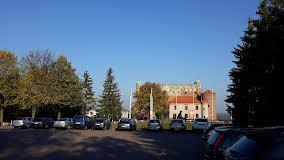
Pay car parks below the castle. Large number of spaces.
Parking
Pay car parks below the castle. Large number of spaces.
 Cuisine
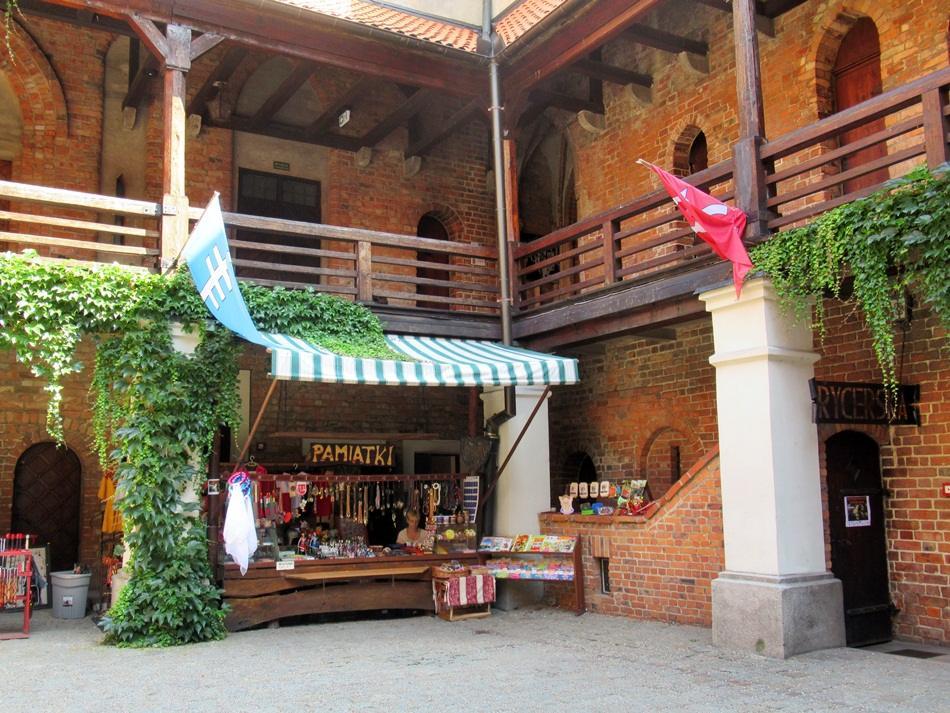
A gift shop for tourists is located in the courtyard of the castle.
Cuisine
A gift shop for tourists is located in the courtyard of the castle.
 Accommodation
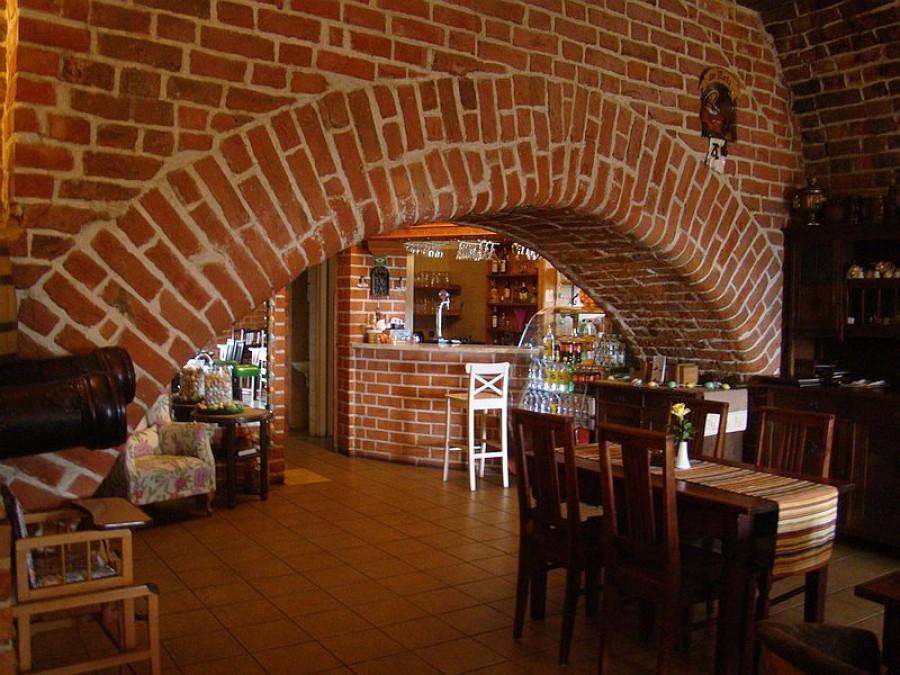
A restaurant is located in the castle grounds.
Accommodation
A restaurant is located in the castle grounds.
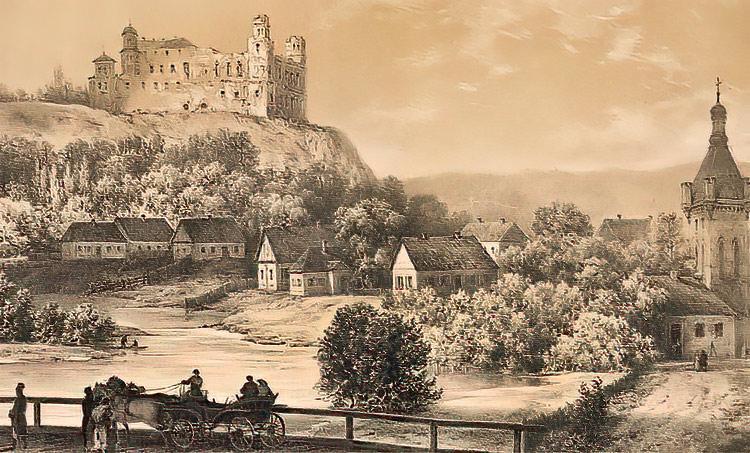
Golub Castle - a four-winged, conventual Teutonic castle from the turn of the 13th and 14th centuries, built on a hill towering over the town, now within the limits of the town of Golub-Dobrzyń; preserved in the Gothic-Renaissance style.
In 1258 the vila Golube was granted to Bishop Wolimir of Wloclawek. By the end of the 13th century there was a wooden fortification guarding the crossing of the Drwęca River, which in 1293, by way of an exchange between the bishopric of Włocławek and the Order, became part of the monastic state. Wooden and earth fortifications were built by 1295.
Construction of the walled castle began between 1304 and 1306 on the initiative of the Prussian State Master Konrad von Sack. Initially only the perimeter of the walls was built, with buttresses at the corners and against the north and south walls. It is possible that already at that time a tower with a hunger dungeon was erected in the north-west corner. The main increase in building work took place between 1305 and 1311, when wings were added to the walls. However, the concept of the original tower in the north-west corner was abandoned when the castle wings were built. The castle was surrounded by a second wall perimeter, and in later years it was reinforced in the western corners, the side most threatened by storm, with two round towers. In the next stage, the southern (main) wing was added, housing the Chapel of the Holy Cross with its ornamental portal and the refectory (formerly mistaken for a chapter house). Subsequently, the west wing was erected and the construction of a square-shaped main tower began on the north-west corner, but was abandoned during the works. The next phase saw the erection of the east and north wings, which differed from the previous ones in style and were slightly lower.
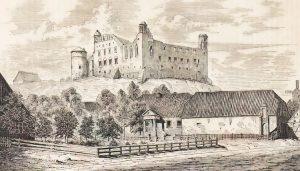
The castle proper had a room layout typical of a Teutonic castle. The cellars were used as storerooms. On the lowest floor, in addition to the guard rooms at the entrance gate, there were rooms with economic functions. The upper floor with the chapel in the south wing was residential and representative. Adjacent to the chapel were two penitential cells, as well as a refectory and infirmary. The commandery occupied the west wing and the east wing was used as a dormitory for the monks. The upper storey was used for the granaries and weapons stores connected to the defensive porch. The cellars and ground floor rooms were usually used as utility and storage areas. A toilet porch was attached to the castle wall to the north, supported by an arcade, accessible via a corridor from the cloister. Instead of the main tower in the corner, the construction of which was abandoned, a cylindrical tower turret was built which was suitable for the use of firearms.
On the courtyard side, the wings were surrounded by arcaded galleries. To the west of the castle was a large rectangular pre-castle surrounded by a separate circuit of fortifications. The rectangle of perimeter walls covered an area of 70 by 100 metres, and was separated from the rest of the hill to the west and the castle proper to the east by wide ditches across the promontory.
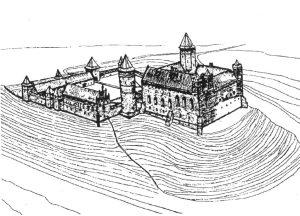
The stronghold above the river crossing has been besieged several times since its foundation. Between 1329 and 1333, Vladislav Lokietek attempted to conquer the castle three times, unsuccessfully. Similarly to other border castles, the castle in Golub was reinforced before the approaching Great War with Poland in 1409, but the military supply was already so poor that the rearmament did not significantly affect the defences of the stronghold.In 1409-11 a part of the monastic army marching to Grunwald gathered here. The local komtur Nicolaus Roder was one of the two hundred brother knights killed during the battle. In 1410, the castle was occupied by Polish knights and handed over by King Władysław Jagiełło to the knight Niemsta from Szczytniki for administration. However, the castle was soon occupied by troops of the Order of the Cavaliers of the Sword supporting the Teutonic Knights, which met with counteraction from Polish troops, who in the autumn of 1410, under the command of Bydgoszcz starost Dobiesław Puchała coat of arms Wieniawa, beat the numerically superior Livonian army near the castle in a battle. After the signing of the First Toruń Peace Treaty in 1411, the castle was returned to the Teutonic Knights.
During the Golub War in 1422, the Polish army captured the town after an artillery barrage from 14 cannons started on 20 August, and then the castle was stormed on 26 August; a komtur was killed during the storming. As a result of the artillery shelling by the Jagiellonian army, the castle was severely damaged. After it was recaptured by the Teutonic Knights, two Polish prisoners of war were imprisoned there, but they escaped from the castle, as is known from a letter from the komtur of Toruń from the summer of 1423. The castle was still being rebuilt after the destruction between 1433 and 1449.
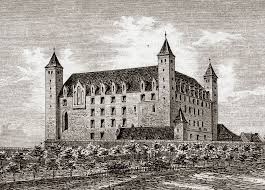
After the outbreak of the Thirteen Years' War in 1454, the castle was captured by the forces of the Prussian Union acting in concert with Poland, after which King Casimir Jagiellon leased it in September 1455 to his courtier Grot of Ostrow, and it was manned by a Czech mercenary hired by the king, Wilhelm Jenik of Mieczykowa, who received the starosty of Golub from the king. In 1456 the castle was given to Ulrich Czerwonka (Oldřych Czerwonka) by the king for his merits. On 19 September 1460 the castle was besieged by a mercenary Teutonic army under the command of Bernard Szumborski, but the Polish garrison of the castle, commanded by Andrzej Puszkarz, managed to repel the attack. The Teutonic Knights took the town of Golub, but were unable to capture the castle for two years. After being freed from a Czech prison, the town was recaptured by Czerwonka in October 1462. After the end of the war, on the basis of the Second Toruń Peace Treaty of 1466, it was incorporated into the Kingdom of Poland, being assigned as the seat of the starost, who became Ulryk Czerwonka. In 1511, by order of Sigismund the Old, the castle was renovated.
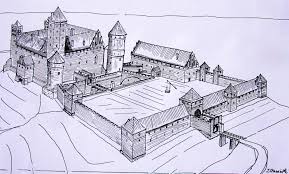
The most serious changes to the castle were made in the 16th century.when it became the property of Anna Vasa, sister of King Sigismund II. In the years 1616-1623′, it was rebuilt on the order of Queen Anna Vasa, who took over the starosty of Golub - at that time, among other things, late Renaissance attics were added, the building on the foreground was rebuilt, the shape of the windows was changed and turrets were added in the corners. It was here that tobacco, imported from Turkey, was first grown in Poland[8]. In 1623, King Zygmunt III Waza stayed in Golub. It was destroyed in 1655 during the Swedish wars. The interiors were renovated in the early 18th century. During the Napoleonic wars, the castle housed a lazaret. Damaged in 1842 and in 1867 when hurricane winds partially collapsed the attics. In 1920 the Polish authorities arranged a museum in the castle. In 1937 the roof and several rooms were renovated.
After the war, the first conservation work was carried out between 1947 and 1953. It was rebuilt and restored between 1959 and 1966 and during further adaptation work after 2006.


