Facilities
 Tickets and guided tours
Tickets can be purchased at the castle reception or, more cheaply, online (zamekreszel.pl/bilety). Self-guided tours are available, whilst guided tours can be arranged by contacting reception. The estimated duration of the tour is approximately 1–1.5 hours.
 Parking
There is a secure car park next to the castle.
 Restaurant
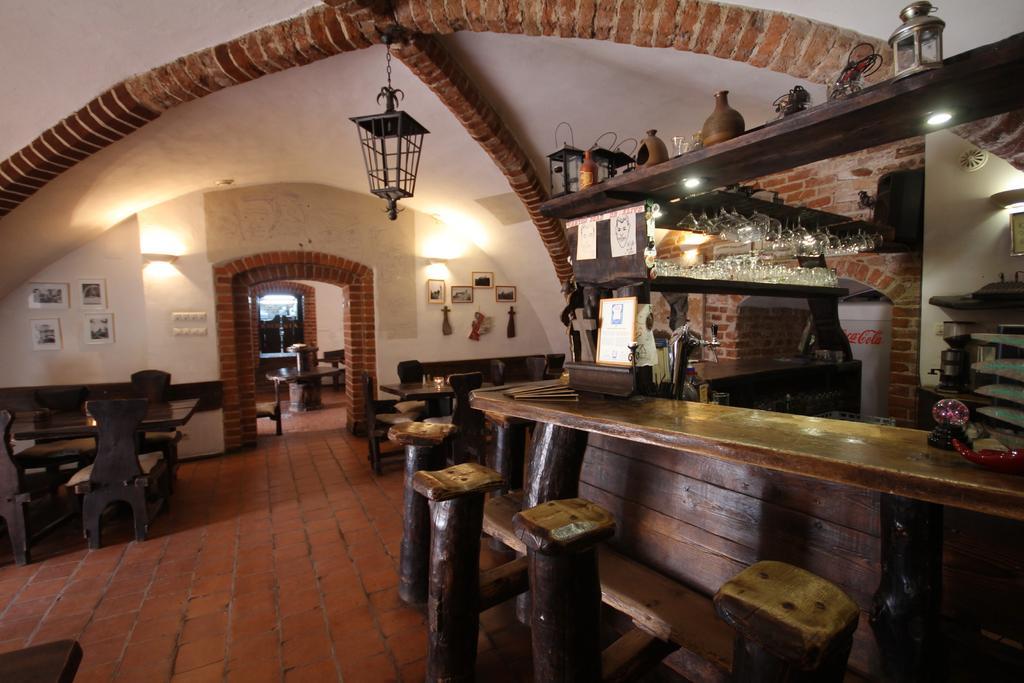
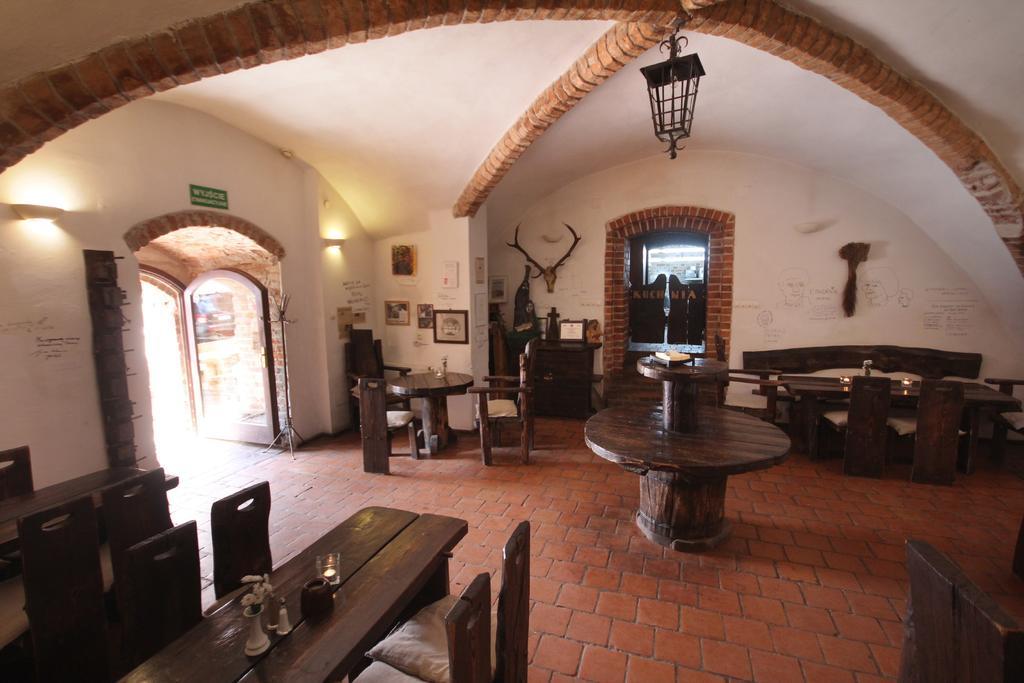
The castle is home to the ‘Siedem Kotów’ restaurant, serving Masurian cuisine, and the ‘Bar Pod Miotłą’.
 Hotel
The castle houses a hotel – the rooms are situated in the former chambers (bookings via zamekreszel.pl).

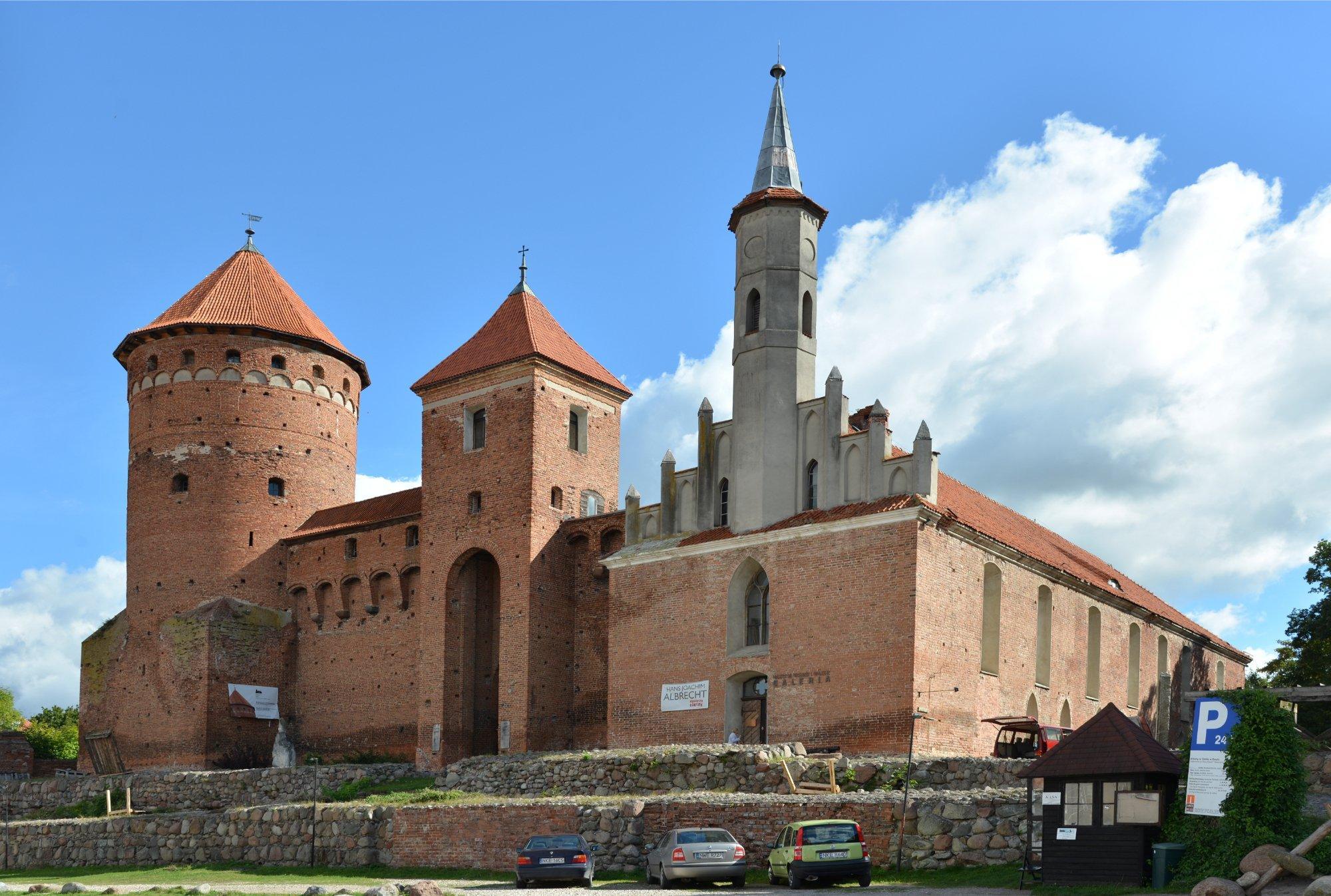
Reszel Castle is a Gothic stronghold dating from the second half of the 14th century, built by the bishops of Warmia on a hill overlooking the River Sajna. For centuries, it served as the seat of the bishops’ officials, and later as a residence, a prison and an Evangelical church. Today, it houses a hotel, a restaurant, an art gallery and a visitor route featuring a viewing tower.
Genesis
A small fort had previously stood on the site of the castle, which the Teutonic Knights used as a watchtower in the mid-13th century. The land belonged to the bishops of Warmia, although monastic garrisons were stationed here for a time. During the Prussian uprising in 1260, the garrison burnt down the watchtower and abandoned the site. The fortifications were rebuilt using a combination of timber and earth, and following the town’s charter under Chełmno law in 1337, construction of a stone castle began.
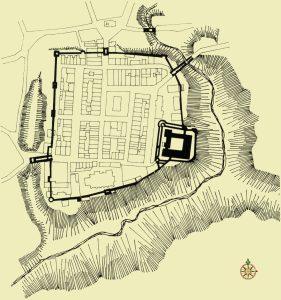
Work began around 1350 under Bishop John of Meissen, was continued by John Stryprock, and was completed in 1401 by Bishop Henry Sorbom. The castle was incorporated into the city walls, and its tower towered above the city’s bastions. It is worth noting that Reszel belonged to the domain of the Bishops of Warmia, and not directly to the Teutonic Order.
Wars of the 15th and 16th centuries
The castle changed hands many times, often without a fight. Polish troops captured it in 1410 and 1414. During the Thirteen Years’ War, the town and its garrison joined the Prussian Union; The Teutonic Knights captured the stronghold in 1455, and in 1462 they handed it over to Bishop Paweł Legendorf. Following the Second Peace of Toruń in 1466, Warmia came under the authority of the King of Poland. In 1472, Bishop Mikołaj Tungen led an unsuccessful siege of the castle, and during the war of 1519–1521, the castle was handed over to the Poles without a fight.
Around 1505, Bishop Łukasz Watzenrode built a new section of wall, designed to withstand firearms. His nephew, Nicolaus Copernicus, who served as the bishop’s secretary and physician, was a frequent visitor to the castle.
From a mansion to prison
Between 1594 and 1597, on the initiative of Cardinal Andrzej Batory, the castle was rebuilt, and in 1596 the main tower was raised. The stronghold lost its military significance and became a residence, also used as a hunting lodge. The building suffered damage during the Polish–Swedish wars of the 17th century.
Following the First Partition of Poland in 1772, Warmia came under Prussian rule, and around 1780 a prison was established in the castle. Between 1806 and 1807, two major fires destroyed the town’s wooden buildings, the town hall, the main tower and the castle buildings.
Barbara Zdunk
One of Warmia’s most notorious stories is linked to the prison in Reszel. Barbara Zdunk, accused of setting fire to the town, was imprisoned here and was burnt at the stake on 21 August 1811. Her execution is sometimes described as the last burning of a „witch” in Europe – although she was formally convicted of arson, not witchcraft. The witch theme features in the castle’s current programme of events.
The 19th and 20th centuries
In 1822, the ruined castle was handed over to the Evangelical parish. The south wing was converted into a church, which explains its unusual shape; the wings were lowered to the height of the curtain walls, and part of the defensive walls, the gate and the towers were demolished. Reconstruction work was carried out during the interwar period and after the Second World War.
In 1958, the castle was taken over by the „Pojezierze” Social and Cultural Association. Between 1976 and 1985, a thorough renovation was carried out and a creative retreat and art gallery were established here; the sculptor Bolesław Marschall was the first to organise these activities. In 2001, following further renovation, a hotel with a restaurant, a gallery and a museum exhibition were opened.
Architecture
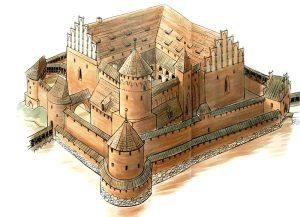
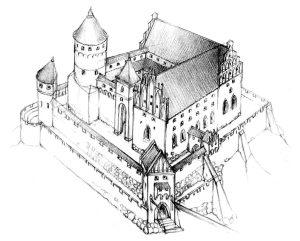
The castle was built of brick on a stone foundation, on a plan approximating a quadrangle measuring approximately 43 by 45 metres, with an inner courtyard. In the north-west corner stands the cylindrical main tower on a square plinth; it had eight storeys, and its walls were over four metres thick at the base. The entrance in the western curtain wall was protected by a gate tower with a drawbridge.
The four-storey east wing housed storerooms, a kitchen and the burgrave’s quarters. The south wing served a ceremonial purpose – it contained the bishop’s chambers, the refectory and a chapel with a star-vaulted ceiling. The buildings were connected by brick cloisters. In the 15th century, an external, lower defensive wall and towers were added to the northern curtain wall, and the entrance was moved to the south-western corner.
The castle today
The castle is managed by Zamek Reszel, which runs a hotel, the Siedem Kotów restaurant and the Bar Pod Miotłą here. The admission ticket includes access to the courtyard and ramparts, the tower with its exhibition and views of the surrounding area, an exhibition of medieval torture instruments (for visitors aged 16 and over), the gallery hall showing the film „The Legend of Święta Lipka”, and attractions for children. Guided tours can be arranged at reception. The castle is one of the most important historical monuments in Reszel, situated on the route to the sanctuary at Święta Lipka.


