
Facilities
 Tickets and guided tours
Tickets can be purchased at the castle ticket office or online at bilety.zamek.malbork.pl. Guided tour with an audio guide; estimated duration: approximately 45 minutes.
 Parking
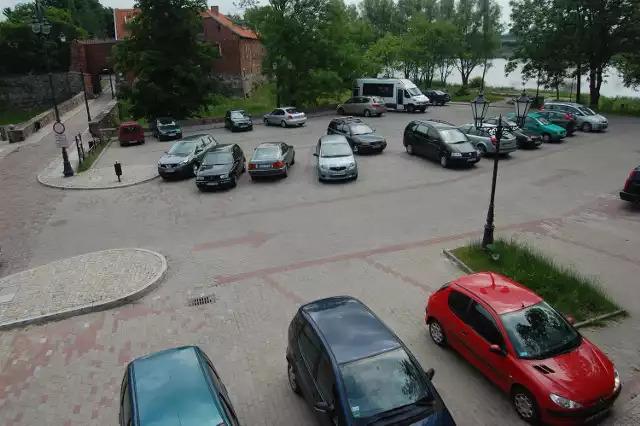
There is parking available near the castle; the museum does not provide any information about the car park.
 Restaurant
There is no restaurant at the castle; there are places to eat in the centre of Sztum.
 Hotel
There is no hotel at the castle; accommodation is available at establishments in Sztum and the surrounding area.
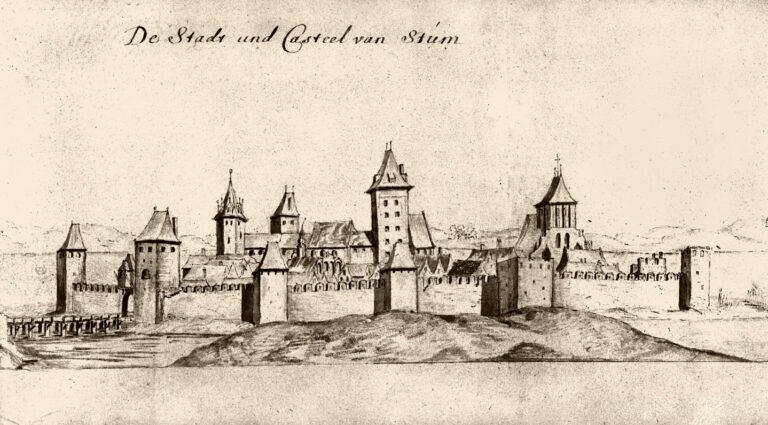
Sztum Castle is a Gothic Teutonic stronghold on Lake Zajezierskie, built in the late 14th century as the seat of the Order’s bailiff. For over three centuries, it served as the seat of Polish starosts, and during the Prussian period, it housed a court and a prison. Since 2018, it has been a branch of the Malbork Castle Museum.
Genesis
Sztum was situated within the territory of the Teutonic Order, on an isthmus between lakes, on the road from Malbork into the heart of Prussia. Construction of the stronghold began after 1377. The foundation of the fortifications is associated with the Austrian Duke Albrecht III, who took part in the crusade against Lithuania alongside Grand Master Winrich von Kniprode. Work continued from around 1380 until the early 15th century.
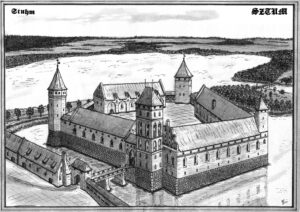
The castle served as the seat of the Teutonic Order’s bailiff and, owing to its proximity to Malbork, was also a frequent residence of the Grand Masters. It stood out amongst the bailiffs’ castles for its unusual layout: it had a very large courtyard and lacked an outer bailey. Within its grounds stood a separate house for the Grand Masters – the residence of the head of the Order, who would come to Sztum to rest, hunt and entertain guests. A menagerie was established near the castle.
Wars of the 15th century
Following the Battle of Grunwald in 1410, the castle was captured by Polish forces. It was recaptured by the Teutonic Knights under the command of Henryk von Plauen; during the fighting, the tallest western tower was destroyed. In 1454, at the start of the Thirteen Years’ War, the castle was captured by Jan Bażyński, but it soon returned to the Order’s hands.
The headquarters of the district administrators
Under the terms of the Second Peace of Toruń in 1466, Sztum became part of Royal Prussia, within the borders of the Polish Crown, and until 1772 the castle served as the seat of the Polish starosts of Sztum. Nicolaus Copernicus stayed here in 1506 and 1512. During the Polish period, the interiors were rebuilt and new buildings were erected in the courtyard, adapting the castle to the administrative needs of the starosty.
In the 17th century, the castle was captured and destroyed on numerous occasions during the Polish–Swedish wars, most severely during the Swedish Deluge of 1655–1660. In 1703, during the Great Northern War, the Swedes captured it for the third time.
The Prussian era
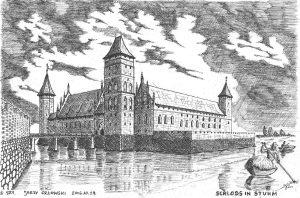
Following the First Partition of Poland in 1772, the castle was taken over by the Prussian administration. It housed the office responsible for managing the royal estates, and later also a court and an orphanage. Over the course of more than a century, the building gradually lost its medieval features: the towers were lowered, one was demolished entirely, and the upper storeys of the magistrate’s wing were removed. Demolition work continued into the 19th century. In 1824, the court was moved to the east wing, and in the second half of the century, court and prison buildings were erected on the castle grounds. The façades of the east wing were then given a Neo-Gothic style. Among other things, the north-east tower, part of the east wing containing the former residence of the Grand Masters, and the west wing were lost.
After 1945
After the Second World War, the castle continued to serve the justice system – a district court and a public prosecutor’s office were based here. From the early 1970s, it housed the Powiśle Museum, and since the 1990s, the Sztum Cultural Centre. In 2010, the castle complex was entered in the register of historic monuments, and between 2017 and 2018 it was taken over by the Malbork Castle Museum, which is carrying out conservation work here and opening the castle to visitors.
Architecture
The castle was built of brick on an irregular polygonal plan, adapted to the shape of the hill overlooking the lake, and features three towers. The residential wing, the gatehouse with pointed-arch recesses in the passageway, and the tower in the north-west corner – known as the prison tower – have survived to this day. Despite the damage, the castle has retained its character as a defensive structure – the perimeter of the walls, the moat and the remains of the towers still define its outline, and from the lakeside it is clear to see how the stronghold made use of its natural position on the escarpment. Part of the former complex is now visible only as the outline of the walls.

The castle today
The castle is a branch of the Malbork Castle Museum. Visitors can explore it with an audio guide available in several languages, including Polish sign language. The courtyard and exhibition spaces are open to the public, and the museum hosts educational activities and cultural events. The courtyards are cobbled, and some of the rooms are accessed via stairs, which is worth bearing in mind when planning your visit. A visit to Sztum can easily be combined with a trip to Malbork – the museum offers a combined ticket for both castles.


