Facilities
 Tickets and guided tours
You can buy tickets on the spot. On weekdays, you can explore the museum at your own pace; at weekends and on public holidays, guided tours depart every hour (included in the ticket price). Allow around 1½–2 hours for your visit. Organised groups should book a time slot by calling 504 051 022.
 Parking
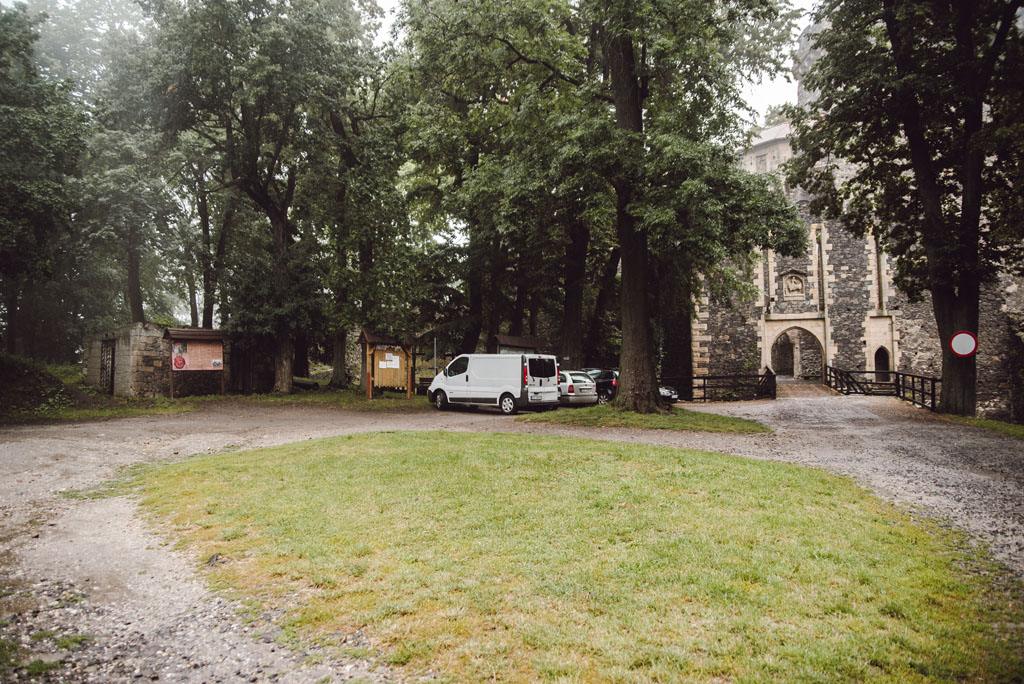
There is a free car park for visitors in the grounds of the castle. You can also reach the castle by bus or minibus from Złotoryja.
 Restaurant
The castle kitchen serves traditional Polish dishes, which are served on the premises within the castle walls. It also prepares meals for groups.
 Accommodation at the castle
Accommodation is available in the castle tower (hostel-style, from 80 zł per person; room with en-suite bathroom 130 zł per person). Breakfast can be purchased separately, and pets are welcome.

Grodziec Castle stands on a basalt hill – a former volcano – in the Land of Extinct Volcanoes, between Złotoryja and Bolesławiec (Zagrodno municipality, Lower Silesia). It is one of the most beautiful Gothic-Renaissance strongholds in Silesia, associated with the Piast princes of Legnica, and, in the 20th century, with the famous story of the treasures hidden here during the Second World War.
Origins (12th–13th centuries)
The first mention of Grodziec comes from a papal bull issued by Pope Adrian IV in 1155 – at that time, it was a fortified settlement belonging to the Bobrzan tribe. In 1175, Prince Bolesław I the Tall granted a charter there to the Cistercian monks of Lubiąż. In the 13th century, historical sources mention the castellans of the stronghold. The original fortifications were wooden; a stone castle was built during the reign of Prince Henry the Bearded, and it was systematically extended over the following centuries.
The Hussite Wars and the Dukes of Legnica (15th–16th centuries)
During the Hussite Wars, the castle was captured, plundered and destroyed. In 1470, it was repurchased by Frederick I, Duke of Legnica, who brought in master masons from Legnica, Wrocław and Görlitz – it is to them that Grodziec owes its present layout. Under his son, Frederick II, the castle became one of the most magnificent Gothic-Renaissance residences in Silesia: between 1522 and 1524, under the supervision of Wendel Rosskopf of Görlitz, Renaissance towers were added on the north and south sides.

The Thirty Years' War (17th century)
During the Thirty Years’ War, the castle served as a refuge for the local population and their belongings. In September 1633, it was captured and burnt down by Albrecht Wallenstein’s troops. According to accounts, the capture was the result of treachery – though it is not known whose. The scale of the destruction was immense, and the stronghold lost its military value. Attempts to rebuild it in the 17th and 18th centuries were unsuccessful.
The first „tourist” monument (19th century)
A turning point came in 1800, when Jan Henryk VI von Hochberg became the owner of the estate. Conservation and restoration work began, though this did not include the ruined keep and palatium. In the 1830s, Grodziec was regarded as one of the first historic sites in Europe to be adapted for visits by tourists.
The Reconstruction of Bodo Ebhardt (1906–1908)
In 1899, the estate was purchased by Willibald von Dirksen. Between 1906 and 1908, the castle was rebuilt to a design by Bodo Ebhardt, a renowned restorer of German castles. Not all parts were reconstructed: the keep and the south-eastern walls were left as permanent ruins, the palatium was given a new hipped roof, and the gates and perimeter walls were also rebuilt. From 1926, the castle was owned by Herbert von Dirksen, a German diplomat.
World War II and post-war times
During the war, the castle housed collections from Wrocław’s museums, the Berlin State Library and the valuable collections of the Ossolineum. In 1945, the castle was devastated: the historic collections were looted and the roofs were burnt down. The building stood abandoned until 1959, when clean-up work and the reconstruction of the damaged parts began.
Architecture
The complex consists of an upper and a lower castle. At the top of the hill stand the palatium, with its castle halls, and a courtyard surrounded by walls featuring guard walkways. Towering above the whole complex are the ruins of the keep – a 15th-century tower with machicolations at gallery level. The Gothic core is complemented by Renaissance towers dating from 1522–1524 and Ebhardt’s 20th-century reconstruction, which deliberately left part of the walls in a state of ruin.
The castle today
The castle is managed by Zamek Grodziec Ltd, whilst the site remains under the care of Zagrodno Parish. Visitors can explore the upper part of the castle: the halls, the guard walkways and the courtyard; an exhibition of instruments of torture is an additional attraction. At weekends and on public holidays, guided tours depart every hour and are included in the ticket price. Accommodation is available in the castle tower, and the castle kitchen serves traditional Polish dishes. Grodziec is also famous for its events – the Knights’ Tournament, the Wine and Mead Festival and the Festival of Blooming Linden Trees – and is a popular choice amongst filmmakers.


