
Facilities
 Tickets and guided tours
Tickets for the castle, stables and coach house are sold at the Museum’s Main Ticket Office in the Maneż building (10 3 Maja Street); some tickets are available online. A visit takes around 2 hours on average, and the number of visitors is limited.
 Parking
The museum does not have its own car park – there is a pay-and-display parking zone in the area (there are spaces for people with disabilities). Coaches park at 17a Kościuszki Street (Transport Centre).
 Restaurant
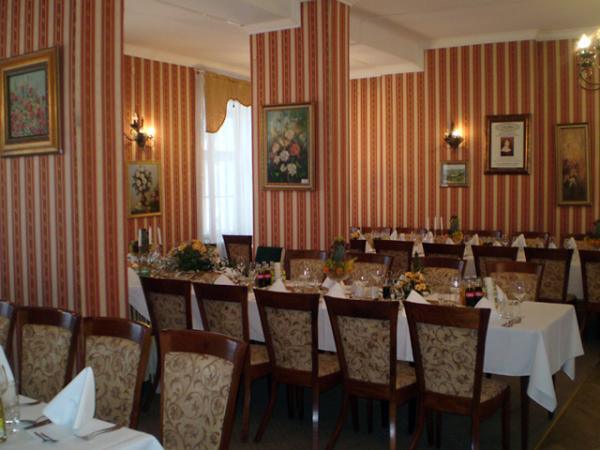
There are restaurants in the centre of Łańcut, just a few minutes’ walk from the castle.
 Hotel
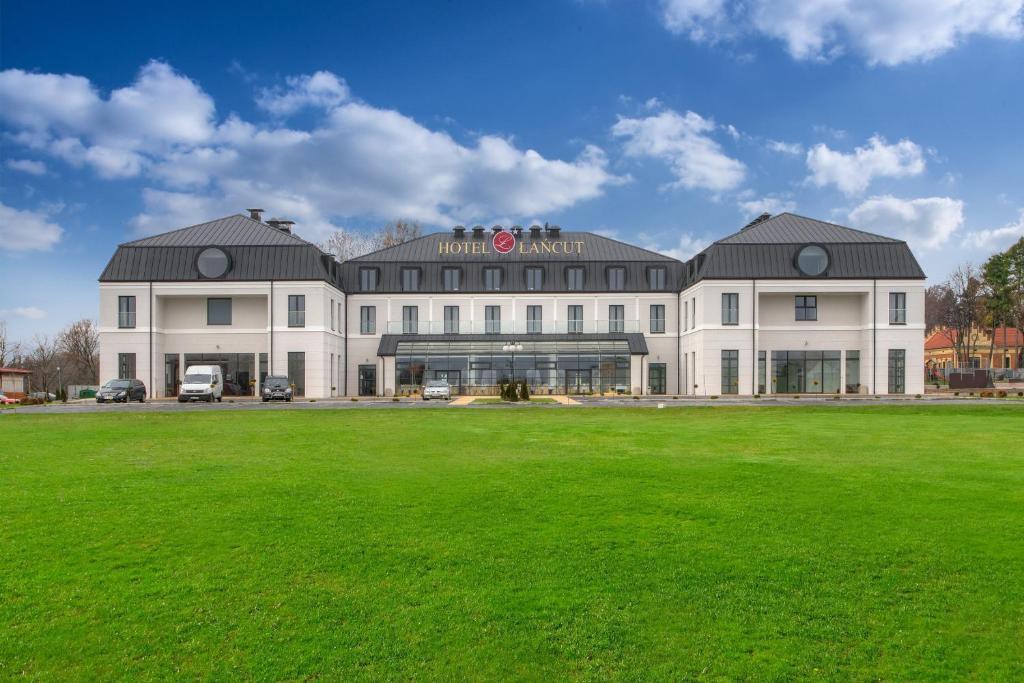
Accommodation is available at hotels and guesthouses in Łańcut and in nearby Rzeszów (approx. 20 km).
 Souvenirs
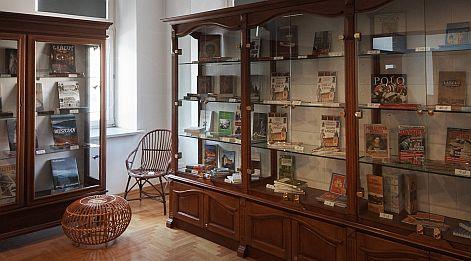
Publications and museum souvenirs can be purchased at the Museum shop, as well as via the online shop.

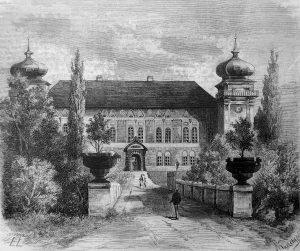
Łańcut Castle, also known as the Lubomirski and Potocki Castle, is one of the most magnificent magnate residences in Poland. For nearly three centuries, it served as the seat of two great families, and since 1944 it has housed the Museum – Łańcut Castle. Together with the park and outbuildings, it forms a complex that was inscribed on the List of Historic Monuments in 2005.
The Pilecki Tower and the Stadnicki Castle
The oldest part of the complex was a defensive tower, probably built by the Pilecki family in the second half of the 16th century. Around 1610, the Stadnicki family extended it into a horseshoe-shaped castle with cloisters and four small bastions at the corners.
Stanisław Lubomirski’s Fortress
In 1629, the Łańcut estate passed into the hands of Voivode Stanisław Lubomirski. Between 1629 and 1641, he rebuilt the castle into a magnificent ‘palazzo in fortezza’-style residence, based on a design by Maciej Trapola, surrounding it with earth-and-brick-brick bastion fortifications on a star-shaped plan and a moat, designed by Krzysztof Mieroszewski. The fortifications were so strong that in 1655 the Swedes did not attempt an assault, and in 1657 the fortress successfully repelled the Transylvanian forces of George II Rákóczi.

The Days of the Marshal’s Wife
In 1745, Stanisław Lubomirski, who later became Grand Marshal of the Crown, became the owner of Łańcut. Following his death in 1783, full control of the estate passed to his widow, Izabela Lubomirska (née Czartoryska), known as the Marshal’s Duchess. It was thanks to her that the castle became one of the most magnificent residences of the era. The following were built at that time: the court theatre (before 1784, one of only two surviving palace theatres in Poland), the Column Hall (1783–1785), the Chinese Rooms, the Sculpture Gallery (after 1791) and the Great Dining Room (1802–1805). The Duchess had part of the fortifications levelled, replacing them with gardens, and commissioned, amongst other things, the Orangery (1802) and the Romantic Cottage (1800).
The Potocki Family Charter
Following Izabela’s death in 1816, Łańcut was inherited by her grandsons, Alfred and Artur Potocki, and in 1830 the estate became an entailed estate, with Alfred Potocki as its first entailee. At the turn of the 19th and 20th centuries, the castle underwent extensive modernisation, and the park largely took on its present form as an English landscape park. A riding arena (1830), stables (1898), a coach house (1902) and an orchid house (1904) were also built at that time.
1944 – the museum’s beginnings
The castle was not damaged during the Second World War. Before the Red Army arrived in 1944, the last heir to the estate, Alfred Potocki, left for the West, taking a significant part of the collection with him. The castle was taken over by the state and, as early as September 1944, it was opened to the public as a museum.

Interiors and collections
Compared to other magnate residences, Łańcut stands out for the richness of its preserved collections and its complete palace and park complex. Visitors pass through the Great Hall with its 17th-century vaulted ceiling, the Ballroom with its five crystal chandeliers, the Great Dining Room, the Column Hall, the theatre and the Sculpture Gallery. Among the most valuable works are a self-portrait by Sofonisba Anguissola from 1556 and a sculpture by Antonio Canova depicting Henryk Lubomirski as Cupid. The castle still houses a magnate’s library comprising some 22,000 volumes, whilst the coach house contains a collection of horse-drawn carriages.
Selected rooms
In the Great Hall, whose layout dates back to the 17th century, the coats of arms of the wives of successive owners of Łańcut from the Potocki family are displayed in the vaulted bays. The Ballroom, the castle’s largest interior, has walls covered in polished stucco in a warm, orange-yellow colour. The Column Hall was created on the site of the former billiard room, and its walls are covered in embroidered Chinese silk fabric. The Sculpture Gallery, occupying the entire south wing, resembles a romantic ruin transformed into a gazebo thanks to its illusionist polychromy; it once housed a collection of ancient art, which has been held in storage at the National Museum in Warsaw since 1951. The walls of the drawing room in the Chinese Rooms are adorned with paintings modelled on the discoveries from Herculaneum.
Park
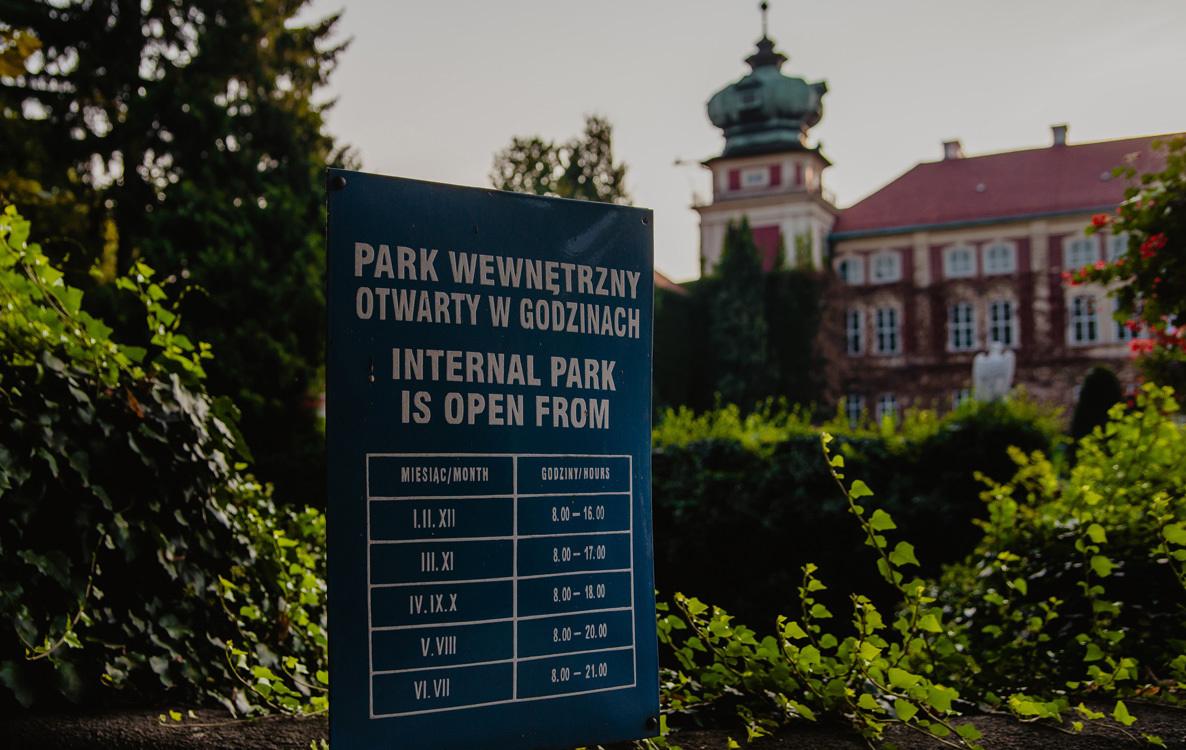
The castle is surrounded by a 36-hectare landscaped park, divided into an inner park within the moat – featuring the Italian Garden, the Rose Garden and a gazebo – and an outer park to the east of the castle. Among the historic buildings in the park are the Orangery, the Romantic Cottage, the riding arena, the stables and coach house, and the orchid house.
Interesting facts
The castle served as a film set – scenes for *The Countess Cosel* (1968) and *The Leper* (1976) were filmed here. Since 1960, the castle has hosted a May music festival, continuing the musical traditions established by the Duchess Marshal, and in 1996 it hosted a meeting of the presidents of Central European countries.
The castle today
Museum – Łańcut Castle opens the ground floor and first floor of the castle, the stables and the coach house to visitors; with separate tickets, visitors can also access the second floor, the castle baths, the orchid house, the exhibition of Orthodox art and the exhibition on the history of the town. The museum also includes the historic synagogue in Łańcut.


