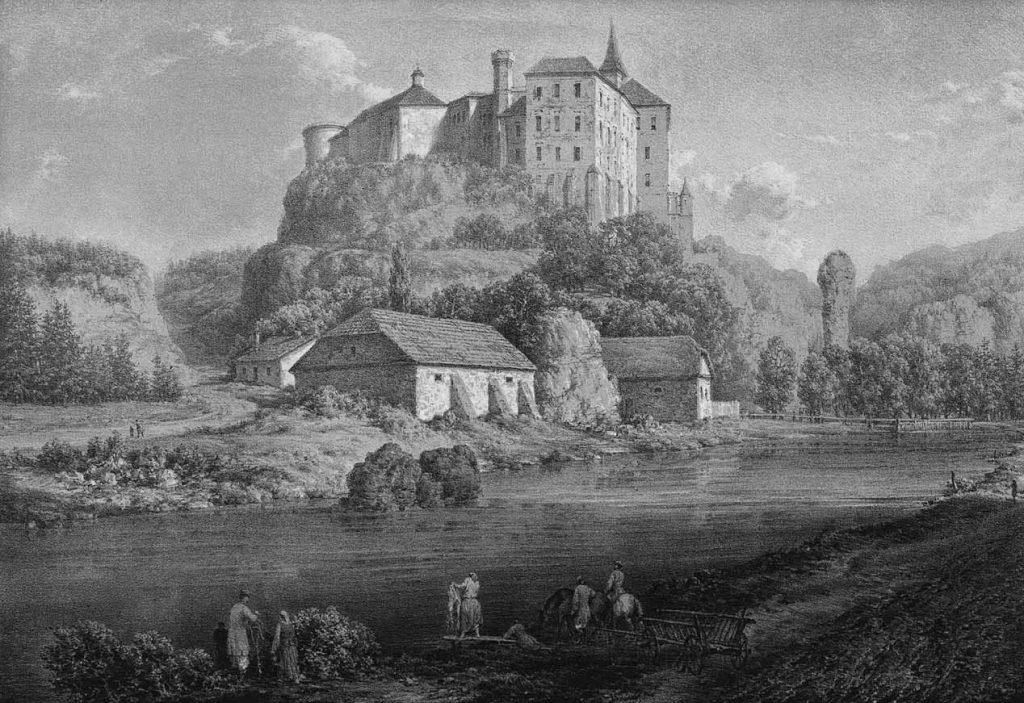
Pieskowa Skała Castle is a unique place located in a picturesque setting in the Jura Krakowsko-Częstochowska region of Poland. This charming castle is part of a castle complex on the Eagle's Nest Trail and has a rich history and remarkable architecture.
Genesis: The origins of Pieskowa Skała Castle date back to the 13th century, when a wooden fortress existed on the site of today's castle. Mentions of the site date back to 1315, when the castle was mentioned in a document by King Władysław Łokietek. Initially, it was a small wooden structure whose main purpose was to control important trade routes and ensure security in the region. Perhaps the castle was built on a rocky hill due to its strategic location and difficult access for possible attackers.
13th century: Mentions of Pieskowa Skała Castle appear in historical sources from 1315. At that time, the castle was mentioned in a document by King Władysław Łokietek. This is one of the first historical mentions of the castle, which proves its existence as early as the 13th century.
Wooden fortress: Originally, the castle was probably a wooden fortress, acting as a defence and controlling the trade and communication routes in the region. Its location on a rocky hill above the River Prądnik made it a difficult defensive point.
First owners: The first known owners of the castle were probably the Silesian dukes, who owned the land in the 13th century. However, the lack of accurate sources makes it impossible to determine the exact first owners and the date of the castle's construction.
The reign of the Lelivites: In the 14th century, the castle passed into the hands of the Lelivite family, noblemen of the land of Cracow. The Leliwici family undertook work to expand and fortify the castle, giving it a new look and function. Its transformation from a wooden fortress into a solid fortress began then. Towers and defensive towers were added, making it a difficult place to conquer in the event of an enemy attack.

Renaissance Redevelopment: In the 16th century, the castle underwent another important phase of development, becoming the property of the Branicki family. It was during this period that it was given its characteristic Renaissance appearance. The castle was rebuilt, adding numerous architectural elements in the Renaissance style, such as arcades, loggias and facade decorations. The castle chapel was extended and decorated with beautiful frescoes, which can still be admired today. This is the period when the castle became not only a defensive site, but also a residence of high standard.
Defence and Conflicts: In the 16th and 17th centuries, the castle continued to perform its defensive function. It witnessed various historical events, such as conflicts with the Rococo, invasions by Swedish troops and conflicts with the Tartars. Its strategic location on the edge of the Kraków-Częstochowa Jurassic Highland made it an important point in the region's defence system.
The Polish-Lithuanian Commonwealth period: In the 17th century, the castle passed into the hands of Polish kings and served as the royal residence during their visits to Malopolska. This was a period when the castle could host Polish monarchs and state dignitaries.
A period of neglect and reconstruction: During the 18th century, the castle suffered partial deterioration. It went through a period of neglect and its technical condition deteriorated. However, in the 19th century, efforts were made to renovate and reconstruct the castle, which restored it to its former glory and contributed to the preservation of this valuable monument.
Today, Pieskowa Skała Castle is an important place on the map of Poland, attracting tourists with its history, Renaissance architecture and beautiful gardens. It is a witness to many eras and events that have shaped its remarkable history and significance.
Architecture: The architecture of Pieskowa Skała Castle is an extremely fascinating example of Renaissance architecture that impresses with its harmony and beauty.
Renaissance style: Pieskowa Skała Castle is an excellent example of Renaissance architecture, elements of which dominate the entire building. This architectural period, characterised by harmony of proportion, rich decoration and symmetry, gives the castle an elegant and majestic appearance.
Arcades and loggias: One of the most characteristic elements of the castle's Renaissance architecture are the arcades and loggias. Repeated arcades decorate the facades of the building and the inner courtyards. Loggias are covered cloisters that open onto courtyards and terraces, creating a harmonious space for strolling and relaxing.
Multi-storey residence: Pieskowa Skała Castle takes the form of a two-storey residence that combines defensive and residential functions. The interiors of the castle are decorated in accordance with the Renaissance style and preserve the authentic character of past centuries.
Pieskowa Skała Tower: An integral part of the castle is its tower, known as the Pieskowa Skała Tower. This imposing tower not only had a defensive function, but also served as an observation point from which the surrounding countryside and roads could be inspected.
Richly decorated facade: The facades of the castle are richly decorated with architectural details such as carvings, friezes, cornices and coats of arms. These decorations emphasise the high status of the castle as a noble residence.
Natural environment: Pieskowa Skała Castle is surrounded by charming gardens, which harmoniously blend into the natural surroundings of the Krakow-Częstochowa Jurassic Highland. The gardens are a place of peace and relaxation, ideal for strolling and admiring the beauty of nature.
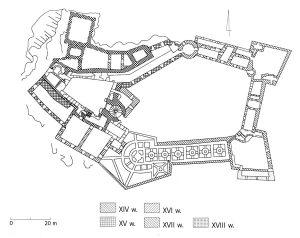
Castle today: Today, Pieskowa Skała Castle serves as an important museum and cultural centre that attracts tourists and lovers of history and culture. Here is a more detailed description of the castle's functions today:
Museum: Pieskowa Skała Castle is a place where one can admire the rich collections connected with the history of the Malopolska region and the history of the castle itself. The museum collects valuable artefacts, furniture, paintings, handicrafts and other works of art, which allow visitors to learn about the history of the region.
Exhibitions: The interiors of the castle have been reconstructed and restored to their former glory, allowing visitors to be transported back in time to centuries gone by. The exhibitions present the different periods of the castle's history, from its beginnings in the Middle Ages to the period of Renaissance expansion and further development. They allow visitors to understand how the site has evolved over the centuries.
Cultural centre: Pieskowa Skała Castle is also a centre for the organisation of various cultural events. Concerts, art exhibitions, festivals, literary meetings and many other cultural events are held within the castle walls. It is a place that attracts both history and art lovers.
Education: The castle also has an educational function, organising workshops, lectures and museum lessons for visitors, especially the younger generations. This is an excellent opportunity to learn about the history and culture of the region in an interactive way.
Thanks to its museum and cultural function, Pieskowa Skała Castle becomes a place that links the past with the present, allowing visitors to discover the secrets of history and enjoy a variety of cultural events. It is also an excellent opportunity to admire the Renaissance architecture of the castle and the natural beauty surrounding this magical place.
Pieskowa Skała Castle abounds with many interesting facts and legends that add to its unique charm:
Legend of the Witch's Castle: One of the most famous legends associated with Pieskowa Skała Castle is the story of a mysterious witch who allegedly lived in the castle's surroundings. According to legend, this witch had immense power and was able to charm people and change the appearance of the castle. It is said that when someone approached the castle with bad intentions, then the castle would become invisible. It's a tale that adds a bit of magic to the place.
Bird's eye view of the castle: One of the interesting facts about Pieskowa Skała Castle is its shape. The castle is situated on a rocky hill and is shaped like a bird. This is a detail that draws visitors' attention and adds to the charm of the castle's architecture.
Carpenter's Gate: The entrance to the castle grounds is through the so-called Carpenter's Gate, which is an impressive example of Gothic defensive architecture. This gate is one of the symbols of the castle and introduces visitors to the unique atmosphere of the place.
Royal residence: During the period of the Polish-Lithuanian Commonwealth, Pieskowa Skała Castle served as a royal residence. Legends say that some Polish monarchs visited the castle and spent time here, surrounded by the beautiful landscapes of the Krakow-Czestochowa Jurassic Highland.
Images in the chapel: In the castle chapel, visitors can admire unique frescoes that depict scenes from the lives of saints and biblical events. These medieval paintings are stunning in their precision and colour, making them an important monument of sacred art.
Knights' tournaments: The castle courtyards often become the arena for spectacular knightly tournaments, where you can watch knightly battles, demonstrations of fencing skills and performances by re-enactment groups. This is a wonderful opportunity to travel back in time to the Middle Ages and feel the atmosphere of those days.
Renaissance garden: Pieskowa Skała Castle is surrounded by a beautiful Renaissance garden, which is a place to stroll and relax. The garden features numerous sculptures, fountains and carefully tended plants, creating a picturesque landscape.
These curiosities and legends make Pieskowa Skała Castle a place not only full of history and architecture, but also magical atmosphere and mystery. When visiting the castle, you can feel the spirit of the past and imagine what life was like there centuries ago.
Pieskowa Skała Castle is a place that delights with its remarkable history, Renaissance architecture and rich cultural heritage. It is a magical place that transports visitors back in time to centuries gone by, while offering numerous cultural and artistic attractions. The extensive gardens surrounding the castle create a picturesque landscape, ideal for strolling and relaxing. Pieskowa Skała Castle is also an educational space, where you can learn about the history of the Malopolska region and the history of the castle itself through numerous exhibitions and displays. It is also a venue for cultural events, concerts and festivals, attracting art and music lovers. Pieskowa Skała Castle is not only a monument, it is also a unique journey in time and space, where you can discover the secrets of past centuries and savour the beauty of Renaissance architecture. It is a place that delights you with its magic and atmosphere and leaves you with unforgettable impressions. We invite you to visit this unique castle and discover its rich history and charm.