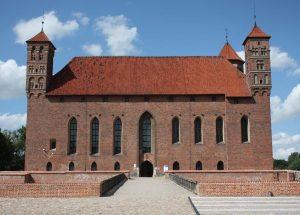
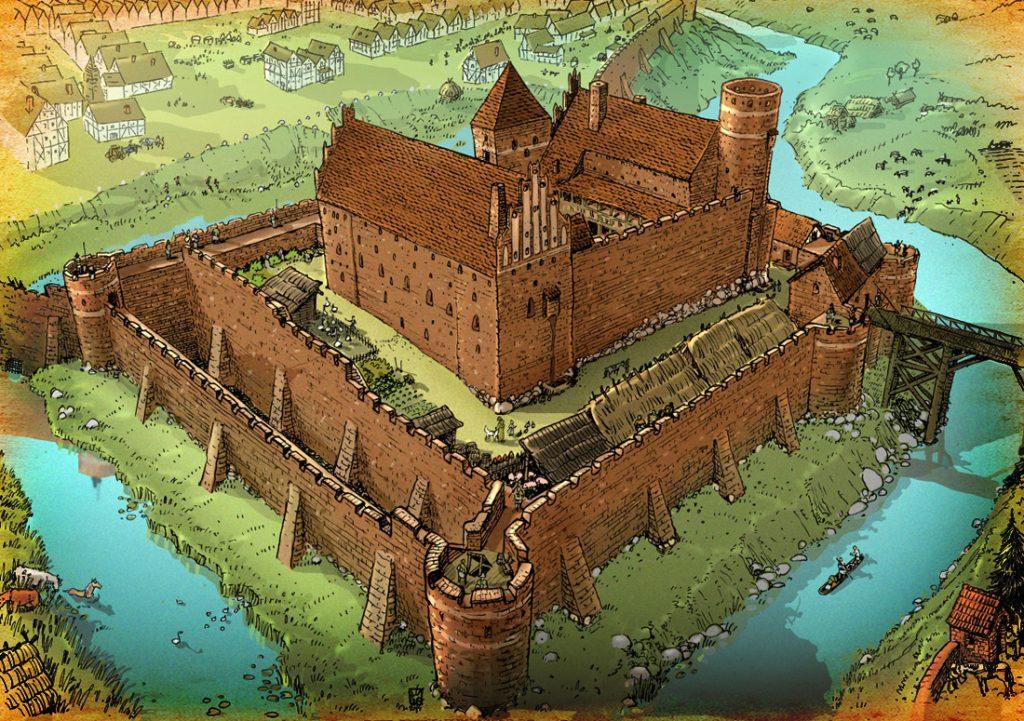
Bishop's Castle in Lidzbark Warmiński - a castle from the 14th century located in Lidzbark Warmiński, one of the most valuable monuments of Gothic architecture in Poland. Since 2018 a monument of history.
The castle was built between 1350 and 1401. The construction work began a year after the seat of the bishops of Warmia had been moved from Orneta (German: Wormditt) to Lidzbark Warmiński (German: Heilsberg). The construction of the castle in its original form was carried out by the bishops, from Herman of Prague to Henry Sorbom. The building was erected on a quadrilateral plan measuring 48.5×48.5 metres. During Bishop Sorbom's tenure, the castle courtyard was surrounded by two-storey cloisters.
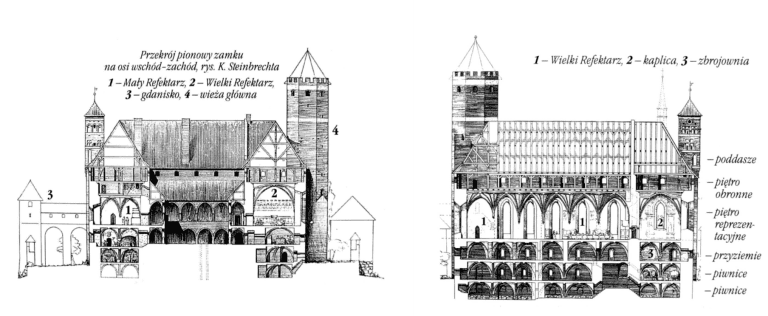
Lidzbark Warmiński Castle consists of:
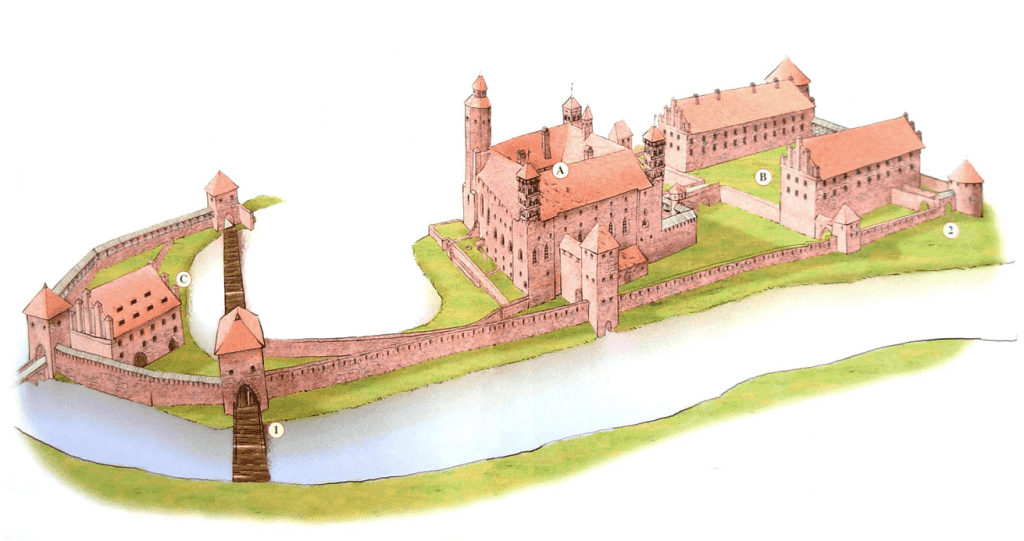
Forecourt , Entrance hall, Castle chapel, Grand refectory, High tower rooms, Audience chamber and the remaining rooms of the first floor.
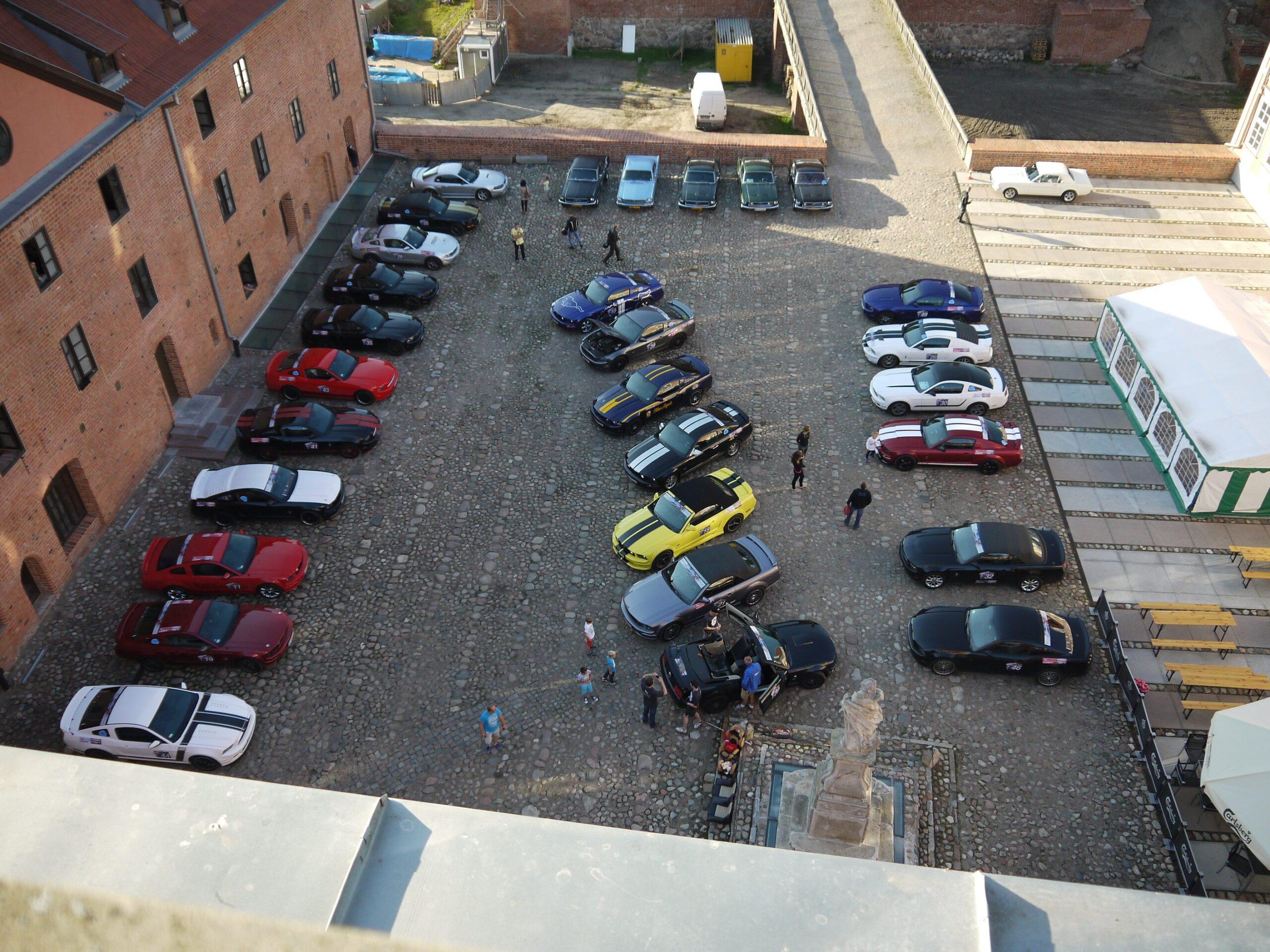
Forecastle It is surrounded by three wings of buildings that have changed their shape and character over the centuries. The east wing in its present form - the palace founded by Bishop Grabowski - was used by the country's alderman and served as a court. The south wing was added at the end of the 18th century by the wall connecting the east wing with the west wing. In the south-east corner of the pre-castle, a cylindrical tower has been preserved (state from the 16th century), and in the central part of the south wing a gate tower from the 14th century. The earliest, in the 14th century, was the west wing of the bailey, which has had its present form since the mid-18th century.
Staterooms The appearance of the rooms and sometimes their functions in the Lidzbark castle changed over the centuries. This was influenced by fashion and the tastes of the users. The palace built by Bishop Wydżga, once standing by the southern wall of the castle, also influenced the changes in the way the castle rooms were used.
Castle chapel is located on the first floor in the eastern part of the south wing. It owes its present Rococo decoration to Bishop Grabowski. Mieczysław Orłowicz wrote about the chapel in this way: The entrance to it is the coat of arms of Cardinal Michał Radziejowski (1679-88). The stellar vault received Rococo ornamentation in the 18th century when the chapel underwent restoration under Bishop Grabowski, as evidenced by his coat of arms next to the organ. There is also a gilded coat of arms of the Bishopric of Warmia made of wood. The wall paintings are of a medium brush, possibly by Jozef Korzeniewski, Bishop Grabowski's court painter. Rococo altars, in the large one there is a painting of the Marriage of St Catherine, a pulpit and an organ. At the wall, a reliquary of St Benedict made of black marble. The altar paintings disappeared in 1945. The missing painting in the main altar was replaced by a painting of St. George (by Josef Korzeniewski) from the Lidzbark parish church.
Grand refectory, also known as the courtroom, now occupies the east wing of the first floor of Lidzbark castle. It is entered from the cloister through a Renaissance sandstone portal bearing the date 1612 and the coat of arms of Bishop Szymon Rudnicki. The room was enlarged during the reign of Bishop Ignacy Krasicki by demolishing the wall separating the grand refectory (originally a five-bay room) from the Sybil Chamber. At present, the grand refectory is a six-bay hall, 27 m long and 9 m wide, decorated with a heraldic frieze with the coats of arms of the bishops of Warmia from Anselm to Wojciech Ziemba. In the refectory there are discoveries of the oldest paintings from the end of the 14th century. The medieval polychrome depicts the coronation of Mary, and the walls were decorated with polychrome with a chessboard motif. In the refectory room, collections of medieval art from Warmia and Teutonic Prussia are exhibited. In the northern part of the room is the tombstone of Bishop Paul Legendorf.
- Tower rooms high from the great refectory is a passage to a room in the high tower of the castle on this level. It served as the bishops' domestic chapel. The decoration of this domestic oratory dates from the time of Bishop Lukas Watzenrode. The chapel is decorated with scenes from the Old Testament: Adoration of God, Moses, the Sacrifice of Abraham and St John on Patmos. The chapel features the coat of arms of Bishop Watzenrode next to the diocesan coat of arms and the coats of arms of Bishop Paul Legendorf and Nicholas Tungen. From the corridor connecting the great refectory with the oratory there is a descent into an unlit room - the prison chamber, known as the Chamber of Forgetfulness. In the middle of its floor is a hole through which prisoners convicted of serious crimes were lowered down with a reel. The room above the house chapel was used as a treasury.
- Audience chamber and the remaining rooms of the first floor. The audience chamber is located in the north wing of the castle. One enters it from the grand refectory or from the cloister through a marble portal (similar to the chapel), funded by Bishop Radziejowski. From the audience hall there is a passage to the former private rooms, including the bishop's bedroom. The west wing of the castle housed a small refectory, and parts of the west and south wings housed the chapterhouse. Gothic paintings have been preserved in the chapter-house rooms: a portrait of the bishops, a scene of the adoration of the Virgin Mary by Bishop Anselm and others. On the ground floor of the castle, the castle kitchen was located under the small refectory. The Lidzbark castle also has a black kitchen on the first floor level.
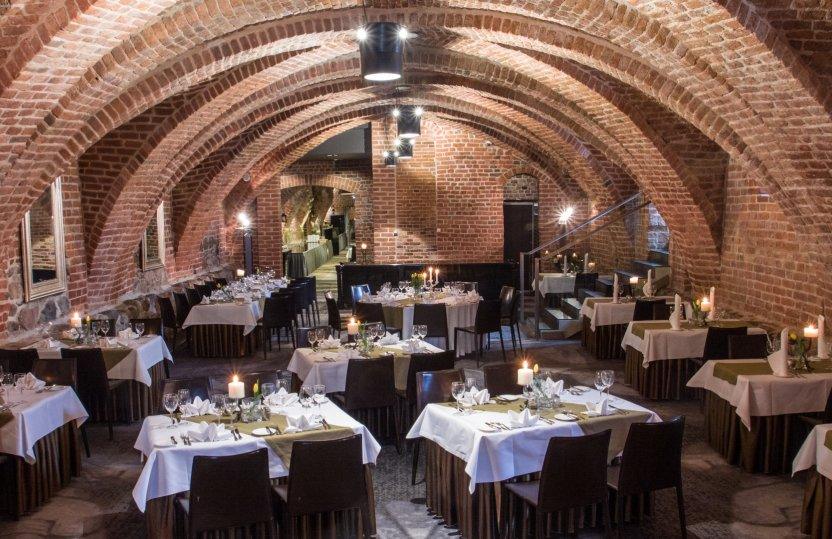
Use of rooms. When Bishop Vydžga's palace was not yet in existence, the rooms on the second floor in the west and north wings were used as living quarters. At present, most of the castle rooms are open to the public as the Museum of Warmia. The dungeons contain an arsenal and a lapidarium, where cannons and stone details and sculptures from the former palace of Bishop Jan Stefan Wydżga are on display. Jan Stefan Wydżga. On the ground floor, collections of Gothic art, portraits, documents related to famous inhabitants of the castle and elements of the former furnishings of the castle halls are displayed. The first floor contains mementoes of the bishops of Warmia, such as chasubles, altar chapels and a large collection of Ignacy Krasicki's memorabilia. The second floor of the castle houses Polish paintings from the 19th and 20th centuries (e.g. paintings by Julian Fałat and Józef Mehofer), while the third floor houses a collection of icons, many of which come from Wojnowo, as well as contemporary Polish paintings (e.g. paintings by Jerzy Duda-Gracz). In the refectory, there is a tombstone of Bishop Legendorf from 1494 by Peter Vischer of Nuremberg.