
Rising on a limestone hill above the city of Będzin, this castle is one of the oldest and best-preserved medieval castles in what is now Poland. Its monumental silhouette, visible from afar, was for centuries a symbol of power and defence, representing a key strategic point on the map of historic Silesia.
Origins and Early History: Będzin Castle, often referred to as the "Eagles' Nest", has its origins in the 13th century. It was probably built on the orders of Prince Władysław of Opole to guard an important trade route - the route leading from Krakow to Silesia. Over the centuries, it witnessed many important events, including invasions, sieges and battles that shaped not only the region, but also the entire country.
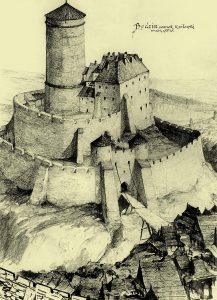
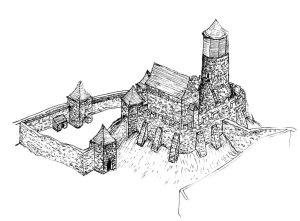
Medieval Fortress and Residence: Będzin Castle is a classic example of medieval defensive architecture. Its original construction was that of a Gothic fortress with massive defensive walls and a distinctive residential tower, several metres high, known as a donjon. This central tower, which once had a residential and defensive function, still dominates the entire complex today.
The medieval period in the history of Będzin Castle was a period of intense activity related to its construction, development and the various events that influenced its history. Here is a detailed description of the medieval period of Będzin Castle:
Reign:
13th century: The origins of Będzin Castle date back to the 13th century, when a wooden fortress began to be built on the site of today's fortress. Initially it was a defensive fortress, built for one of the Silesian dukes, probably Prince Władysław of Opole.
14th century: In the 14th century, the castle was owned by the Opole princes. Throughout this period it passed into various hands and was used for defensive purposes on many occasions.
15th century: During the 15th century, the castle was destroyed by various wars and invasions. However, at the end of the 15th century it was rebuilt and extended.
16th century: In the 16th century, the castle came into the possession of the Będziński family, who contributed to its expansion and modernisation. At that time, among other things, the castle was built as a Renaissance residence.
Architecture and Alterations: Over the centuries, the castle has undergone various reconstructions that introduced Renaissance and Baroque elements into its structure. Despite these changes, the castle has retained its medieval character, which still attracts crowds of tourists and history enthusiasts. An exemplary example of medieval defensive architecture in Poland, Będzin Castle presents itself as a monument with a complex and multi-layered structure, the result of numerous alterations and adaptations carried out over the centuries.
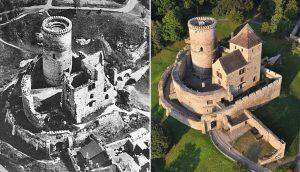
Architectural elements:
Donjon (residential tower): The heart of the castle is the massive rectangular residential tower, known as the donjon, which dates back to the 13th century. The tower, which is the dominant defensive and representative element, rises to an impressive height and was originally separated from the rest of the building. The donjon was not only the last defensive bastion, but also the main feudal residence, where the most important living and utility rooms were located.
Walls and towers: The castle is surrounded by defensive walls which, together with the towers, formed a defensive system. These walls were built of local limestone, which ensured the solidity of the structure. The towers, placed at strategic points, served not only as defensive points but also as watchtowers and prisons.
Courtyard: The central courtyard was the inner heart of the castle, serving as an economic function and meeting place. Around the courtyard were spread the main utility rooms, including the storerooms, stables and also the kitchen.
Gothic details: Characteristic Gothic elements, such as ogival windows and doors, are visible in the oldest parts of the castle. Reinforcements in the form of battlements and buttresses further emphasise the military character of the building.
Renaissance and Baroque redevelopments: In later periods, the castle underwent reconstructions that introduced Renaissance and Baroque elements to its body. The Renaissance adaptation mainly involved the modernisation of the interiors, the introduction of richer decorations and the widening of the windows, which gave the building a more representative character. The Baroque modifications particularly affected the details, such as the window and door carpentry, as well as the decorative interior facades.
Contemporary renovations: The castle underwent extensive restoration and conservation work in the 20th century, aimed not only at preserving its historic appearance, but also at adapting it for modern tourist and cultural functions.
Environment: The castle is situated on a natural hill, which further strengthened its defences and provided an important architectural feature. In the immediate surroundings of the castle, although no longer a medieval structure, there is a green landscape that once had defensive functions as moats and earthen ramparts.
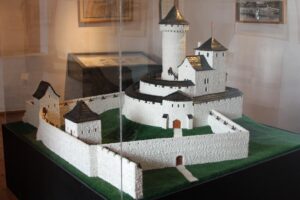
The Castle in Culture and the Arts: Będzin Castle has been an inspiration for many artists, writers and poets. Its majestic and austere figure has appeared in numerous works of culture, being a symbol of the steadfastness and history of the Zagłębie Dąbrowskie region.
Castle Today: Today, Będzin Castle is a valued monument that attracts visitors wishing to experience the atmosphere of former centuries. Thanks to careful restoration work, the castle has not only retained its historical value, but has also been opened to the public, offering a rich educational and cultural programme.
Będzin Castle is a place where history comes alive, allowing you to immerse yourself in stories of knights, wars and legends of bygone eras. Today, Będzin Castle attracts tourists with its history and architecture, allowing visitors to travel back in time to the Middle Ages and learn about the history of this important place on the map of Poland.