The castle in Sztum is undeniable evidence of the rich history and cultural heritage of the Pomeranian region. Rising majestically above the surrounding area, the castle is a symbol of power, defence and strategic importance that has attracted the attention of various dynasties, knights and kings over the centuries. Its roots can be traced back to a time when the area witnessed dynamic political and military changes, and castles such as this one were not only witnesses but also key actors in these events. In the heart of the picturesque scenery, the castle in Sztum is not only a testimony to the past, but also an inspiration for contemporary history and culture enthusiasts wishing to explore the mysteries of times gone by and discover the extraordinary stories associated with this monumental site.
Genesis: The origins of the castle in Sztum are closely linked to the activities of the Teutonic Order in the Baltic region and its desire to consolidate its control over the strategic areas of Gdansk Pomerania.
Teutonic Order in Pomerania: After its foundation in the Holy Land, the Teutonic Order moved its operations to the Prussian and Pomeranian lands with the aim of converting the pagan Baltic peoples to Christianity and extending its dominance in this part of Europe. Strongly organised and resourceful, the Order established numerous fortresses to serve as bases of operations, administrative centres and points of defence in case of conflict.
The strategic importance of Sztum: The location of Sztum was extremely advantageous from a military point of view. The castle controlled an important trade route through the region, which connected important urban and economic centres. In addition, the castle was close to borders with other important territories, which emphasised its strategic importance.
Fortress construction: The Teutonic Order, realising the strategic importance of Sztum, decided to erect a solid fortress there. Built of stone walls and surrounded by a moat, the castle was ready to defend itself against possible invasions. Its high towers and massive towers made it unconquerable in those days.
Control of the region: The castle in Sztum became a symbol of the Teutonic Order's power and dominance in the region. By controlling the trade routes and surrounding areas, the Order was confident that its influence in the region would be maintained and the local tribes and towns subjugated.
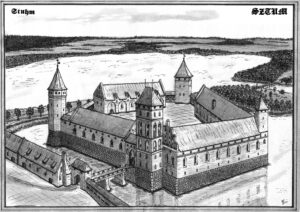
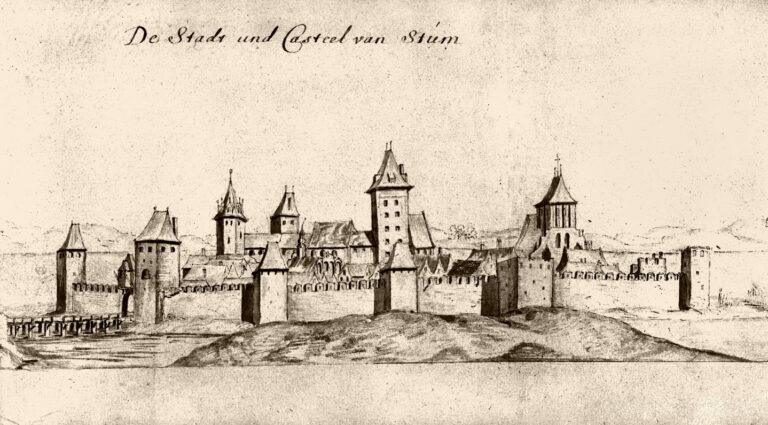
The castle in the time of the Order (13th-15th centuries): Over the following centuries, the castle in Sztum served as the administrative and military headquarters of the Teutonic Order. It was expanded by adding massive defensive walls, towers and moats to increase its defences. During this period, the castle witnessed numerous conflicts and skirmishes that took place between the Order and local tribes and other countries. The castle in Sztum witnessed intense political, military and cultural activities during the reign of the Teutonic Order. Rising in a strategic location, the castle was not only the seat of the Order's administrative and military authorities, but also an important centre of control over this Baltic region. The castle was significantly expanded and fortified. The walls were strengthened and became powerful defensive bastions, capable of withstanding prolonged sieges. In addition, high towers were created which acted as observation towers and defensive points, enabling the defenders to defend themselves effectively against possible invasions. Deep moats were dug around the castle, which were filled with water, further increasing its defences. These moats were difficult for enemies to cross and provided an additional barrier in the event of attempts to capture the castle. The defence system also integrated various fortifications and forts, which enabled effective defence in case of attack.
Conflicts and Skirmishes: The castle in Sztum witnessed many conflicts that took place in the region. The Teutonic Order conducted numerous campaigns to expand its power and influence, leading to skirmishes with local Baltic tribes and other states. The castle was repeatedly the site of sieges and battles, in which the castle defenders defended themselves with determination and courage.
Administrative and Cultural Centre: In addition to its defensive function, the castle also played an important role as an administrative and cultural centre. The interiors of the castle were decorated with rich ornaments, and its chambers were a place for meetings, deliberations and important ceremonies. The Teutonic Order promoted culture and science, which meant that the castle was also an educational and artistic centre.
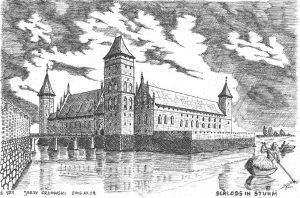
Castle after the fall of the Order (15th-18th century): As a result of the wars with Poland, which led to the fall of the Teutonic Order, the castle in Sztum became part of the Polish Kingdom. In the following centuries, it was adapted for various functions, including as an administrative headquarters or a prison. In the 18th century, the castle was partially destroyed by fire, after which it was abandoned and fell into ruins. After the collapse of the Teutonic Order, the castle in Sztum found itself in a new reality, which was a geographical, political and cultural meeting point between the Kingdom of Poland and the areas of the former Order.
Transition under Polish Authority: After the wars with the Teutonic Order and the Treaty of Torun in 1466, the castle in Sztum, like other areas of the monastic state, was incorporated into the structures of the Kingdom of Poland. It formed an important part of the Polish defence strategy in the north and was administered by Polish starosts.
Adaptations and New Features: During the 16th and 17th centuries, the castle was adapted to new functions. Its interiors were transformed to serve as an administrative seat for the local authorities, a place for meetings and administrative decisions. In addition, at one time the castle also served as a prison, where people arrested for various offences were held.
State of Defence and Modernisation: Although the castle was no longer used as extensively for defensive purposes as it was under the Teutonic Order, it still played an important role in the defence system of the Polish Kingdom. Some of its fortifications were renovated or adapted to meet the requirements of modern warfare.
Fire and Ruins in the 18th century: In the 18th century, the castle experienced a tragic fire that caused considerable damage. After this event, most of the castle buildings were abandoned and their ruins gradually deteriorated. Over time, the castle in Sztum ceased to serve any function and fell into disrepair, becoming a symbol of the passing of the Teutonic Order's power and importance in the region.
Revival and Restoration (19th to 21st century): In the 19th century, the castle in Sztum was discovered by romantics and history enthusiasts, who attempted to reconstruct it. In the 20th century, restoration work began to restore the castle to its former glory. Thanks to the efforts of many people and financial support from various sources, the castle in Sztum was restored and opened to the public.

Architecture: The architecture of the castle in Sztum, built by the Teutonic Order, is an example of Gothic defensive architecture, characteristic of medieval defensive buildings in Europe.
1. Defensive Walls: The centrepiece of the castle is the massive defensive walls, which were intended to provide security for the internal castle structures. These massive walls, made of stone, were often several metres thick, making them resistant to siege attacks.
2. towers and towers: The castle in Sztum was equipped with towers and bastions, which had an observation and defensive function. The towers, rising above the defensive walls, enabled the guards to observe their surroundings and repel enemy attacks.
3rd Moat: The castle was surrounded by a moat, filled with water, which further strengthened its defences. The moat served as an obstacle to the enemy, making it impossible to attack the castle walls at close range.
4. Entrance Gates: The entrance to the castle was through the main entrance gate, which was often the only place through which one could enter the castle interior. These gates were well protected and equipped with defence mechanisms such as a drawbridge or steel bars.
5 Internal Buildings: Within the castle walls there were various buildings serving different purposes - from residences for the monks to kitchens, chapels and storerooms. The internal architecture of the castle reflected the functionality and social hierarchy in medieval society.
6 Architectural Detail: Although the castle in Sztum had a primarily defensive function, some of its elements, such as windows or portals, may have contained decorations and ornaments typical of the Gothic style, such as masquerades or pinnacles.
Today, the castle in Sztum is a popular tourist destination and the cultural centre of the region. Its impressive ruins are a reminder of times gone by and the role it played in the history of Pomerania.