
Built in the mid-14th century in the Gothic style by the Warmian Chapter, which owned it from 1397 to 1772, the castle had defensive functions and was the seat of, among others, the administrator of the chapter's estates. The most famous inhabitant of the castle was Nicolaus Copernicus, who served as administrator in the years 1516-1521. An original astronomical plaque has been preserved on one of the walls. The former refectory and the administrator's chamber have unique crystal vaults dating from around 1520. The castle now houses the Museum of Warmia and Mazury.
The astronomical table in the Olsztyn castle is the only surviving astronomical instrument made and used by Nicolaus Copernicus. Copernicus imported the red paint for the charts from Italy, and the black lines were added after his death in an attempt to convert the plaque into a sundial. The plaque bears traces of damage resulting from alterations to the cloister over the centuries. Copernicus' research was used to reform the calendar in 1582 by Pope Gregory XIII - the introduction of the Gregorian calendar.
In the north wing, Gothic ceiling beams dating from 1370 and 1373 have been preserved. In the south wing, the ceiling beams and hurdy-gurdy were made of timber felled in 1425-29. The defensive capacity of the hurdy-gurdy was never tested.
Architecture
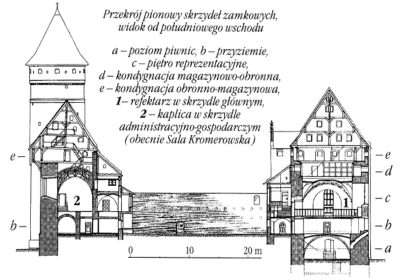
The oldest building in present-day Olsztyn is the Castle of the Warmian Chapter, mentioned in the foundation charter of the town of 31 October 1353, already having in its surroundings a pre-castle, a mill and a mill ditch . Olsztyn Castle is built of brick, on a stone foundation, on a quadrangular plan. There is no doubt that work on the construction of the castle itself and its ramparts had to be carried out in stages. Of course, the status of the fortress in 1353 is not precisely known. What is certain is that the construction of the curtain walls of the castle proper was combined with the construction of the first castle wing - the northern wing, which combined the functions of residential and representative space with farm buildings. The western part of the wing had two basement storeys, the eastern part one, and a vaulted basement above. The first floor, which was occupied by the administrator of the Olsztyn chamber (in the years 1516-1521 it was the canon Nicolaus Copernicus), contained a chapel covered with a stellar vault, as well as a refectory and a flat with a chancellery, probably originally covered with beam ceilings. The upper storeys of the castle wing, with strong beam ceilings, and the attic were used as warehouses. The transport of goods was provided by a goods shaft, made in the thickness of the courtyard wall, operated by a winch suspended from the roof structure. The representative first floor of the Gothic wing of the castle was preceded from the courtyard by a gallery. The north wing was probably completed around 1373. The exterior was decorated with two identical pinnacle gables, segmented with ogival blendes pierced with circular windows and topped with vimpergas with florets. The plasterwork of the blendes was covered with painted masquerade decorations, typical of the Gothic architecture of Warmia and Teutonic Prussia .
Already during the construction of the tower, it was planned to build the second, south wing of the castle - initially a low, single-storey wing. Eventually, in the course of construction that lasted until around 1429, this wing was given an overhanging hurdy-gurdy on the outside, hidden slightly behind the east gable, while on the courtyard side the three upper storeys were given a timber-framed façade .
On the Łyna side, the outer wall is preserved with a semi-circular shell tower, remnants of a corner rectangular tower and a rectangular guardhouse building, adjacent to a stone bridge over the Łyna. On the town's side, in the moat, the remains of a cylindrical tower. From the south, the so-called salt storehouse, a 17th-century building of the castle garrison converted into a salt storehouse in the 19th century, closes the interim wall. The causeway to the town divides the moat into two parts, one of which is occupied by the Czesław Niemen Amphitheatre. At the entrance to the causeway from the town, there is a statue Ławeczka z Kopernikiem (Copernicus Bench) from 2003 by Urszula Szmyt. In the courtyard there are three Prussian statues - the "Prussian women", the Versailles border stone from 1919 from the Polish-German border and a well. On the middleground, near the tower, the 1973 stone sculpture "Solar System" by Belgian artist Jean-Marie Bechet.
The castle was built on an inherently defensive site, on a hill in a wide bend of the Łyna. The town developed on its south-eastern side, also in the bend of the river. On the other side, to the north-west, a castle farm was established, and at the foot of the castle on the river, a mill. The farmstead probably served as a pre-castle area, with the road to the castle leading through it. The town and the fortress were separated by a moat, fed by the waters of the Łyna.
The castle was built of brick on a stone foundation. Its oldest part was the main north-eastern residential wing and the perimeter wall with a gate. In the 1470s, a square-plan tower was placed in the western corner and a building with economic, administrative and perhaps residential functions was placed at the south-western curtain. In the last decade of the 14th century the perimeter walls and both opposite wings were raised.
The main house eventually took the form of a four-storey building with two decorative stepped gables crowning the shorter sides. It was adjoined from the side of the courtyard by two-storey cloisters. The layout of the rooms was modelled on the Teutonic Order assumptions, although the representative rooms were relatively low in Olsztyn. The spacious cellars were cross-vaulted and reinforced with additional vaulted arches. In the western part they had two storeys. The ground floor rooms were originally also cross-vaulted and housed the armoury, the larder and the castle manager's chamber. Below, at basement level in a separate room, the chapter treasury was probably located. On the first floor were the administrator's chamber with a latrine bay, the three-bay refectory and the two-bay St Anne's chapel on the east side. The refectory and the administrator's chamber received magnificent crystal vaults, while the chapel received a stellar vault. The third and fourth floors were single-spaced, with a defensive porch running around. An interesting and unusual solution was the placement of the lift shaft at the level of the refectory. Ropes were used to hoist goods up to the upper levels. The representative floor could be reached from the cloister, which was also connected to the defence porch at the north-west wall. The upper floors could be reached by a spiral staircase located in the thickness of the wall. When the main house was raised by a fourth storey, the new defence storey was located higher than the porch of the curtain wall connecting the house with the corner tower. Probably in order to connect them, the curtain wall was added next to the building, placing a passage in it, and the resulting superstructure was crowned with a small Gothic gable.
At the end of the 14th century, the south-western building also received a new three-storey building with storage and residential functions. It eventually reached the same height as the main house, but has a lower roof due to its narrower base. It has no cellars; the ground floor houses the kitchen, the bakery, the brewery with a malt house, and the keeper's room at the gate. The first floor housed the official rooms and the burgrave's flat. The upper storeys were used for storage and defence, and the façade facing the town was decorated with a pointed gable. Communication was provided by a two-storey wooden cloister. In 1530-1531, the castle chapel, made together with the sacristy by master Mikolaj from Olsztyn, was moved to this wing. It was topped with a rich net and ribbed vault.
On the outside, the walls were topped with hurdy-gurdys and the corner tower then received a cylindrical, single-storey superstructure. It was raised again in the 15th century, when it reached nine storeys. On the fifth and seventh floors, traces of fireplaces have been preserved to heat the rooms of, perhaps, the sentinels. The residential function of the tower is also evidenced by the relic of a toilet bay on the Łyna side. The door on the first, cylindrical floor of the tower led to the defensive porch of the curtain wall, while from the upper floor a passage led to the hurdy-gurdy of the south-west wing.
The exact appearance of the gate tower leading into the castle courtyard is not known. All we know is that it had a quadrilateral base and a pointed gateway passage. The 15th century saw the construction of the outer wall with the Lower Gate, preceded by a bridge over the Łyna. The perimeter of these walls was reinforced with cylindrical towers and the castle, while maintaining its strategic and communicative autonomy, was connected to the town fortifications.
History of the Castle:
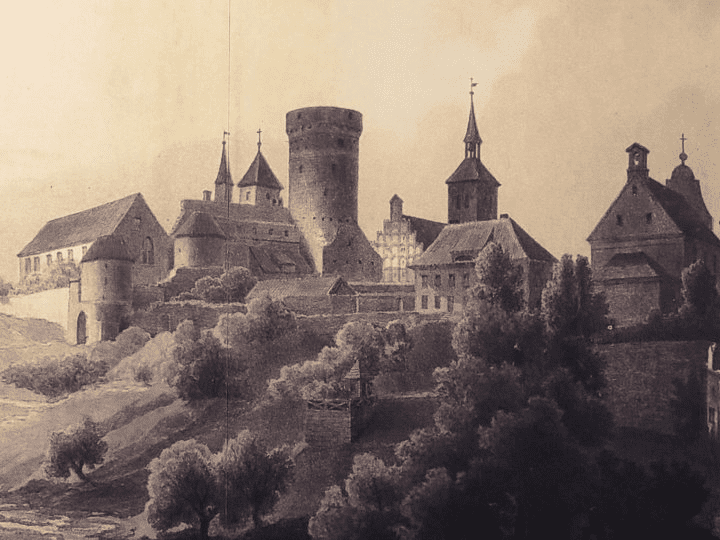
Around 1334, a wooden and earthen watchtower was built on a hill in a bend of the Łyna. On its site, the Warmian chapter began the construction of a brick castle, which was built between 1348 and 1353, when the town was granted town rights. At the time, it consisted of one wing on the north-east side of the quadrangular courtyard. Access to the castle, surrounded by a belt of ramparts and a moat, was from the Łyna River via a drawbridge. The south-west wing of the castle was built in the 15th century. The tower from the middle of the 14th century, located in the western corner of the courtyard, was rebuilt at the beginning of the 16th century, giving it a round shape on a quadrangular base and a height of 40 m. At the same time, the castle walls were raised to a height of 12 m and supplemented with a second belt of lower walls, reinforced with towers. The system of castle walls was partially connected with the town walls, so that the castle became a powerful bastion protruding beyond the town and defending access to it. The castle belonged to the Warmian chapter, which, together with the Warmian bishop, was under the military protection of the Teutonic Order until 1454. For this reason, it played a significant role during the Polish-Teutonic wars. In 1410, after the Battle of Grunwald, it surrendered without a fight to the Poles, while in 1414 they captured it after a siege of several days. During the Thirteen Years' War (1454-1466) it changed hands. The Teutonic Knights threatened the castle and the town as late as 1521, but the defence was so effective that they stopped after one unsuccessful assault. The chapter entrusted the administration of the Olsztyn bailiwick to a canon elected annually from its midst, called the administrator. In the years 1516-1521, with a short break, the administrator of the Olsztyn chamber was Nicolaus Copernicus. It was he who prepared the defence of Olsztyn against the Teutonic invasion. In the 16th century, Olsztyn was also home to two bishops of Warmia and great writers: Jan Dantyszek, the "first Sarmatian poet", who received an imperial laurel for his "Latin songs" (1538, 1541), and Marcin Kromer, who was equally at ease writing scientific and literary works in Latin and Polish (1580). Kromer then consecrated St Anne's Chapel, recently built in the south-west wing of the castle and endowed with an elaborate lattice vault.
Over time, both wings of the castle lost their military importance and became unsuitable for residential purposes. In 1758 an access from the town was added to the castle and the palace wing was built on this side, at the same time removing the courtyard and part of the walls. In 1779, Ignacy Krasicki stayed here. After the annexation of Varmia (1772), the castle became the property of the state landowners; for some time it also housed an Evangelical parish. In 1845, the bridge over the moat was replaced by a causeway connecting the castle with the town, and the moat was drained. In 1901-1911, in connection with the election of the castle as the seat of the president of the Olsztyn regency (the equivalent of the voivode), a general renovation of the castle was carried out. At that time, the floor level in the refectory was changed, window frames were fitted in the cloister and a neo-Gothic staircase was added. The castle tower, which lost its helmet (conical roof) in a storm in 1821, was re-topped in 1926 after more than a century. In 1921, a museum was placed in the rooms of the castle. At that time, it was a regional museum with an ethnographic character, whose management was in the hands of Olsztyn teachers: Leonard Fromm, an archaeologist, and Hugo Hermann Gross, a nature teacher. The castle still serves museum purposes today. In 1945 the castle became the seat of the Masurian Museum, which today is called the Museum of Warmia and Mazury. In addition to its exhibition activities, events organised here as part of the Olsztyn Summer of Arts (OLA), such as castle evenings and "Sundays at the Museum", are very popular.
Reconstructions
The 16th century brought the first reconstructions of the Olsztyn castle. Probably in the years 1510-1520, perhaps the master Matz from Gdańsk, a well-known builder of many crystal vaults, made similar vaults on the first floor of the northern wing, each of the two rooms having a different drawing and geometry). Even before 1530, the skeleton courtyard wall of the south wing was walled on two sides (both outside and inside) with brick, and this state of affairs - with the wooden structure "sunk" into the thickness of the wall - has survived to the present day. Under a 1530 agreement with the local master builder Nicholas, St Anne's chapel appeared in the south wing, covered by a vaulted ceiling
net, with an annex containing the sacristy and the castle vicar's flat, known as the Bird Chamber.
In later centuries, the castle underwent two more major reconstructions affecting its external appearance: the construction of a Baroque palace on the foundation of the
the eastern curtain wall and the eastern so called "high wall" in the years 1756-1758 and the reconstruction of the northern and eastern wings for the office and official residence of the president of the Olsztyn regency in the years 1909-1911.
Roof trusses
Above the northern wing of the castle, an orchid roof truss has been preserved, reduced twice (transversely and longitudinally). This truss was built around 1373, while the ceiling between the first and second storeys of the granary and the defence, on which the truss beams of the roof truss were additionally supported, was put in place after 1370. The pine roof structure was built immediately after the last felling, as can be seen from the longitudinal cracks running through the carpentry assembly marks, caused by the drying of the wood. The rafter framing was therefore built from freshly cut timber.
of harvested timber, which was worked shortly after felling, marked during the so-called de-bonding of the trusses on site and built in, while the drying process took place after the construction had already been completed. The carpentry installation marks of the timber framed walls of the hurdy-gurdy. Above the south wing of the castle there is also an orchid rafter framing reduced twice (transversely and longitudinally), made together with the hurdy-gurdy from pine around 1429.
It is a single-tiered, three-course truss, with an orchid in every second truss, suspended from the ridge and from the overall mayflies, with the orchid also connected to the two lower mayflies by a pair of short centerboards. All trusses have footed swords and short swords above the lower mayflies. Orchid frame, consisting of a foundation and three levels of rafters,
is stiffened by long parallel braces, sloping towards the west gable, connecting two orchids each and all levels of the rafters. The orchid frame provides longitudinal bracing for the entire roof truss and
leaning against it, brick gables, erected after the trusses were installed.
The roof truss was constructed together with the top storey of the south wing, provided with a timber-framed hurdy-gurdy overhanging the outer wall. The columns of the outer and inner walls of the timber-framed hurdy-gurdy were braced to the trusses of the roof truss with ogee-braced joints, and both structures were marked with a uniform, elaborate system of carpentry assembly marks, which has survived to this day in an almost complete state.
During the war with the Teutonic Knights in the summer of 1410, the fortress was briefly occupied by Polish troops, who handed it over to Duke Janus I of Mazovia, who received Oster Rhoda and Działdowo in addition to Olsztyn. Polish rule in Olsztyn did not last long, returning to the chapter in the autumn. Four years after these events, during the so-called Hunger War, on 8 August 1414, the Poles were again at the walls of the fortress. On hearing of their arrival, the garrison was evacuated, with the result that the castle was captured effortlessly by a detachment led by the knight Dzierslaw of Vlostovice and remained there until September, when the castle was captured by the commander of the Gestin army Helfric Von Drach. After the war, the outer masonry ramparts were extended to become the lower gate, which was then the main entrance to the castle. The solid perimeter is reinforced with a cylindrical tower, partly adapted for the use of firearms. In the first half of the 15th century the Olsztyn fortress was joined to the town fortifications, but it retained its strategic and communication autonomy and was separated from the town by a wide moat.
At the start of the Thirteen Years' War (1454), the burghers, dissatisfied with the increased tax burden, marched on the castle with the intention of demolishing it. Their intentions were strikingly bold, but as is the case in life, little came of these plans and the attempt eventually ended with the keys being taken away from the chapter administrator and one of the bridges being burnt. The following year, the fortress was tricked by a mercenary commander in the service of the Order, George von Schlieben, who first forced the canons to give way and then imprisoned them all. In 1466, by virtue of the Peace of Toruń, Olsztyn, together with the whole of Warmia, was annexed to Poland. At the beginning of the 16th century, the interiors in the south-western house were rebuilt and new vaults were made in the residential building and the chapel. It is possible that these works were carried out under the supervision of Nicolaus Copernicus, who lived here in the years 151621 (with a year's break) while acting as administrator of the Warmia chapter's estates. The astronomer commanded the successful defence of the fortress, which took place in 1520 during the last Polish-Teutonic war.
During the war with the Teutonic Knights in the summer of 1410, the fortress was briefly occupied by Polish troops, who handed it over to Duke Janus I of Mazovia, who received Oster Rhoda and Działdowo in addition to Olsztyn. Polish rule in Olsztyn did not last long, returning to the chapter in the autumn. Four years after these events, during the so-called Hunger War, on 8 August 1414, the Poles once again stood at the walls of the fortress. On hearing of their arrival, the garrison was evacuated, with the result that the castle was captured effortlessly by a detachment led by the knight Dzierslaw of Vlostovice and remained there until September, when the castle was captured by the commander of the Gestin army Helfric Von Drach. After the war, the outer masonry ramparts were extended to become the lower gate, which was then the main entrance to the castle. The solid perimeter is reinforced with a cylindrical tower, partly adapted for the use of firearms. In the years between the wars, the tower's helmet, damaged in a fire a century earlier, was rebuilt, and the first archaeological investigations were carried out. The monument, which was not destroyed during the Second World War, currently serves as a museum.
To this day, the medieval seat of the bishops of Warmia has been preserved in remarkably good condition, and against the background of most similar buildings, this graceful castle makes a very favourable impression. Today, it houses the Museum of Warmia and Masuria, and since 1997 it has also been home to the Knights' Brotherhood. The valuable and extensive collections include, among others, an archaeological exposition, a collection of decorative arts, handicrafts, contemporary art and old icons. A separate place is occupied by a permanent biographical exhibition devoted to Nicolaus Copernicus presented in the chamber of the great astronomer. In addition to the museum, the castle houses a small gallery and a souvenir shop, and there is a café in the bailey.