Genesis of the Castle
Człuchów Castle (German. Ordensburg Schlochau) is one of the most important medieval Teutonic fortresses, whose origins are directly related to the ambitious expansion policy of the Teutonic Order into Prussia and Pomerania in the 13th and 14th centuries. Construction of the fortress began around 1325 and was completed forty years later, in 1365. Its construction was a response to the need for a strong checkpoint on the border between the Teutonic Order's lands and Gdansk Pomerania, in a key location for trade, administration and military purposes.
The location of the castle was chosen extremely carefully - on a natural hill called "Kępa", surrounded by lakes: Urzędowym, Miejski and Rychnowski. This layout not only provided excellent defensive qualities, but also allowed full control over local trade routes, which ran both by water and by land, connecting the German Reich with Prussia and the Livonian lands. Particularly important was the location of the castle in a place that could provide security for further Teutonic warfare and trade expeditions towards Lithuania and Rus. The Order was intensively expanding its network of fortresses - and Człuchów was to play a major role in it.
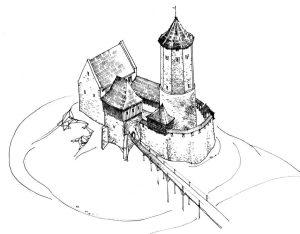
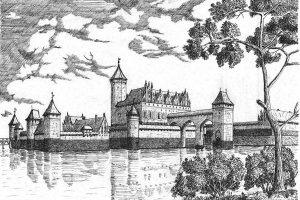
The original architectural concept envisaged the construction of a four-winged main castle (known as the 'Castle of the Seven Wings'). conventshaus), around which three extensive pre-castle areas were created. The whole was surrounded by a double system of moats - including one filled with water, about 25 metres wide, and another, dry, running from the eastern side. Further reinforcing the natural defences were the wetlands, making it difficult to approach the walls. A massive gate with a drawbridge led into the castle from the land side, and the whole complex was fully self-sufficient, with outbuildings, granaries, a brewery, a chapel and living quarters for the monks and servants.
The castle in Człuchów was not only a building of strategic importance, but also the seat of a komtur - a senior official of the Order - who exercised administrative and judicial power over the surrounding komturdom. As such, the castle also served a representative function, holding assemblies, war meetings and receiving deputies and dignitaries. It was the centre of a well-organised monastic authority to control the surrounding lands, enforce taxes and duties and defend the borders of the monastic state.
The origins of the castle in Człuchów show how much importance the Teutonic Order attached to the spatial planning and logistics of its warfare and economic activities. This building, although not as well known today as its Malbork counterpart, is an exemplary example of medieval fortification thought and perfectly illustrates how multifaceted the Order's expansion strategy was - military, political and economic at the same time.
History of the Castle
History the castle in Człuchów is turbulent history, which perfectly reflects the changing fortunes of the whole of Pomerania and the lands of the monastic state. From its foundation in the 14th century until its decline in importance at the time of the partitions, the castle served not only as a military fortress, but also as a centre of power, diplomacy and administration - first of the Teutonic Order and later of the Polish Kingdom.
Teutonic Order and Tłuchów Commanders
From the very beginning, the castle was the seat of the Teutonic Commanders and Convent - one of the most important centres in the western part of the monastic state. Influential representatives of the Order resided within its walls, including such prominent figures as the Conrad von Wallenrode - later Grand Master - and Ulrich von Jungingen, who also assumed the highest office in the order and died during the Battle of Grunwald in 1410. The presence of such personalities testifies to the prestige of the Człuchów commandery and the strategic importance of the castle as an operational base and administrative centre.
An impregnable fortress - the wars against Poland
Człuchów Castle became famous for its exceptional military resilience. In 1414, during the so called "battle of Człuchów". the hunger warand also in 1433, during the invasion of the Hussite army allied with Poland, the fortress successfully repelled sieges. Even after the great defeat of the Order at Grunwald in 1410, when many castles surrendered to the Polish-Lithuanian army, Człuchów remained unconquered, becoming one of the Order's bastions of resistance in western Prussia.
The Thirteen Years' War and change of ownership
A turning point in the history of the castle came during the the thirteen-year war (1454-1466), which ended with the incorporation of Royal Prussia into the Kingdom of Poland. Already in 1454 the castle was captured by the Polish army, and the Teutonic Knights unsuccessfully tried to regain it in the following years - in 1455 and 1456. Człuchów was never again returned to the control of the Order. By virtue of Second Peace of Torun of 1466 became part of the Commonwealth of Poland and has since served as the the seat of the non-garden starosty.
Residence of the Polish nobility
From the end of the 15th century until the partition in 1772, the castle in Człuchów was the residence of the royal starostswho administered the local estates on behalf of the king. This office was held by prominent Polish aristocratic families. Wejherowo, Sanguszko, Radziwiłł - who took care to keep the castle in good shape, while gradually adapting it to a more residential than military function. Despite its changing function, the castle still had to fulfil its original role more than once.
The Swedish Deluge and the last moments of glory
During the Swedish Deluge, in 1655, the castle once again played the role of a strategic fortress. Thanks to an exceptionally cold winter, the castle remained inaccessible for a long time - the moats and lakes effectively blocked access for enemy troops. Eventually, however, when the lakes froze over, the castle was captured by the Swedes, which was a symbolic end to its glory as a defensive bastion. After the wars ended, it gradually lost its importance.
Collapse after partition
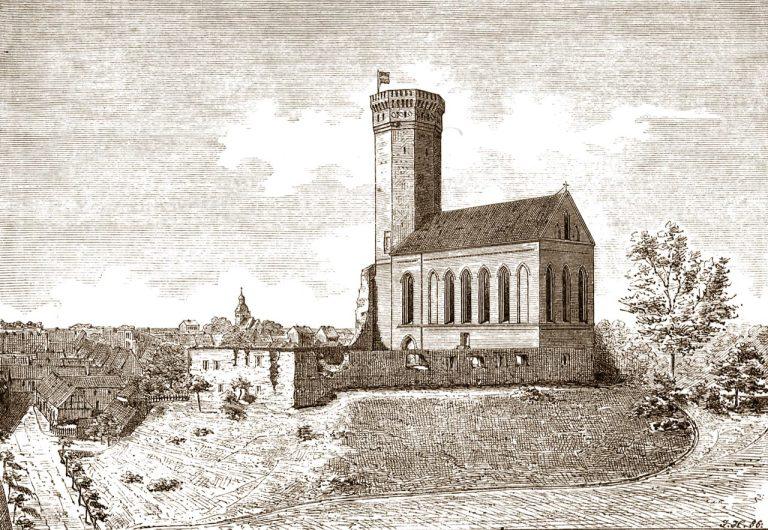
After the First Partition of Poland in 1772 Człuchów was incorporated into Prussia and the the castle began to fall into disrepair. The Prussian authorities no longer recognised its military or historical value - the demolition of a large part of the walls and buildings began, and the building material obtained was used for new investments, including the construction of a nearby church. The only well-preserved element remained the main castle towerwhich was even lowered for some time. It has survived to the present day as a characteristic dominant feature of the city skyline, reminding us of the former power of this Teutonic fortress.

Architecture and its Key Features
Architecture the castle in Człuchów is one of the finest examples of monumental Teutonic construction, which combined military, administrative and representative functions. Although today its walls are partially preserved and the full silhouette of the fortress is known mainly from reconstructions and archaeological studies, the grandeur and precision of the construction still inspire appreciation among researchers and visitors alike.
The momentum and scale of the building
In its heyday, the Człuchów castle covered an area of as much as three hectareswhich made it one of the largest fortresses of the Teutonic Order - second in size only to the famous Malbork Castle. The complex consisted of the quadrilateral High Castle with sides 47.5 metres long and three pre-castles, which had economic, military and communication functions. The High Castle was the heart of the fortress, surrounded by inner courtyard with cloisters and laid out in four storeys, which was characteristic of monastic castles of the highest status.
Dominant feature of the landscape - the main tower
The most recognisable feature of the castle was and remains powerful main tower, built on an octagonal plan in the north-west corner. It originally reached more than 50 metres highand now - after being lowered in the 18th century - measures approximately 45 metres. Its massive walls and slender silhouette towered over the surrounding area, acting as both a watchtower and a symbol of the Order's power. The tower offered a view of the entire surrounding area and could act as the last point of resistance in the event of a siege.
Moat and bridge system
The castle was built on what is now known as the 'Castle of the World'. Kępie - natural elevation surrounded by the Municipal, Urzędowe and Rychnowskie Lakes, which gave it an almost island-like character. It was surrounded by two moats: to the west was the water moat with a width of 25 metres, while to the east - the dryThe castle's main entrance was a fortress, which further secured access to the fortress. The fore castles were connected to the main part of the castle by drawbridgeswhich enabled access to be effectively cut off in the event of an emergency. Entrance gate was located in the north wing and led into the courtyard of the high castle.
Functional layout
The internal organisation of the castle was subject to strict monastic rules and the daily rhythm of convent life. The individual wings had strictly defined functions:
North wing housed the religious chapelwhich was not only a place of daily prayer, but also a space for official ceremonies.
East wing was intended for chapterhouse - the convention meeting room - and dormitorywhich is the common bedroom of the monks.
W west wing was located refectory, the convent's dining room, where silence was enforced and Scripture was read out during meals.
South wing It was used as a residence for guests and dignitaries - there were representative guest chambers.
In the basement and cellars were placed warehouses, armoury, milland later - in Polish times - also brewerywhich demonstrates the adaptation of the space to changing needs.
Style and building materials
The castle in Człuchów was built in the style of a Brick Gothic, characteristic of the Teutonic state. The foundations are made of fieldstonewhich ensured the stability of the structure, while the higher parts of the walls were built of red brickThe walls of the castle are of the highest quality, moulded and laid out with great precision. The regular wall faces, pointed-arch windows and architectural details betray the high building culture and influence of the Baltic Gothic, typical of the regions controlled by the Order.
One of the lesser-known but extremely intriguing pages in the history of Czchów Castle is its function after the First Partition of Poland, when the area came under Austrian rule. At that time, the medieval tower, originally used for military and observation purposes, was adapted as a prison. Its austere stone interiors and inaccessible location made it an extremely difficult place to escape, which perfectly suited the needs of the partitioning authorities. This fact not only underlines the versatility of the castle's defensive architecture, but also enriches its history with a repressive and dark theme, giving it additional historical depth.
The castle has long fascinated artists and travellers. Already in the 19th century, during the Romantic era, its ruins attracted attention as a symbol of former splendour and transience. It was then that the famous lithographs by Adam Gorczyński and Maciej Bogusz-Stęczyński appeared, depicting Czchów as a place full of melancholy, wild beauty and steeped in history. Their works not only immortalised the castle in the artistic canon of Poland, but also contributed to its recognition among art lovers and sightseers.
The geographical location of the castle is also not without significance. It is located at a point where three important and symbolic historical paths cross. The first is the medieval trade route, which led from Krakow through the Dunajec Valley towards Hungary and was one of the main merchant routes in this part of Europe. The second is the modern route, linked to the Partition period and the subsequent administrative actions of the Austrians. The third is connected with the dramatic events of the 20th century, as there are visible remnants of World War II, including trenches and fortifications of the "Kochbunker" type, which were part of the German defence system.
The presence of these historical layers in one place makes Czchów not only a point on the tourist map, but also a space of memory, where the history of the Middle Ages, modern times and the present day intertwine. The castle, although small, tells a story much broader than just its own - it becomes a witness to the fate of the whole region and its inhabitants over the centuries.
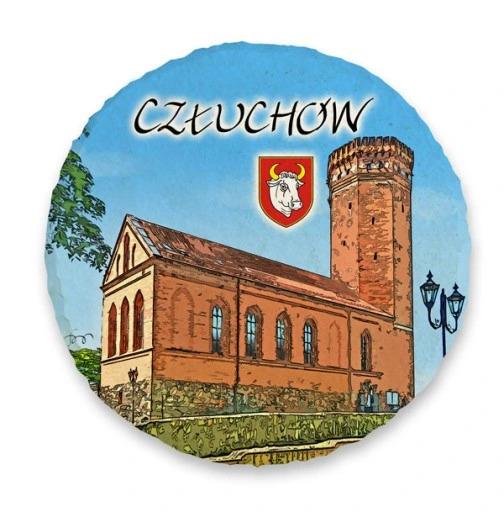
Although time and historical storms have not spared the castle in Człuchów, thanks to the efforts of conservators and local history enthusiasts, this once mighty fortress is once again beginning to regain its former glory. Currently, the castle serves as the seat of Regional Museum in Człuchówwhich is housed in the restored interiors of the High Castle. Its monumental tower - damaged, lowered and forgotten for centuries - has been painstakingly reconstructed in recent years and opened to tourists as a vantage point from which to view the panorama of lakes, forests and the city.
Castle Today
Today's castle is not only a tourist attraction, but also a centre for culture and educationwhich hosts temporary exhibitions, historical reconstructions, concerts of early music and workshops for young people. Walking through the ancient courtyards and soaking up the atmosphere of the Gothic walls, you can almost hear the echo of the monks' medieval prayers, the clack of armour and the sound of horses' hooves bouncing on the stone pavement.
For Człuchów, the castle is not only a relic of the past, but a living symbol of the town's identity - a witness to centuries of splendour, decline and rebirth. From its original military and administrative function, through its role as the residence of the royal aldermen, to its ruin and reconstruction - the history of the castle is a story enchanted in bricks and stone. Its presence attracts lovers of history, architecture and art, becoming an integral part of the cultural landscape of Pomerania.
Człuchów Castle - once the second largest fortress of the Teutonic Order - today inspires and teaches again. It reminds us of the richness and complexity of the region's history and at the same time shows that even from ruins it is possible to build again a space full of life, memory and the spirit of past eras.